
Australia Confronts Extremism After the Bondi Massacre.Australia is confronting a renewed reckoning with violence and extremism following the Bondi Massacre, a deadly attack that unfolded in one of Sydney’s most frequented public spaces. The incident has triggered national mourning, intensified political debate, and a broad reassessment of how a country long perceived as relatively insulated from mass-casualty attacks should respond to emerging threats.
For Australians, the attack cut deeply into a sense of everyday security. Bondi Junction, a busy commercial and social hub, represents ordinary urban life rather than a symbolic or political target. That ordinariness has made the tragedy more unsettling, reinforcing concerns that violence driven by extremism, grievance, or instability can erupt without warning.
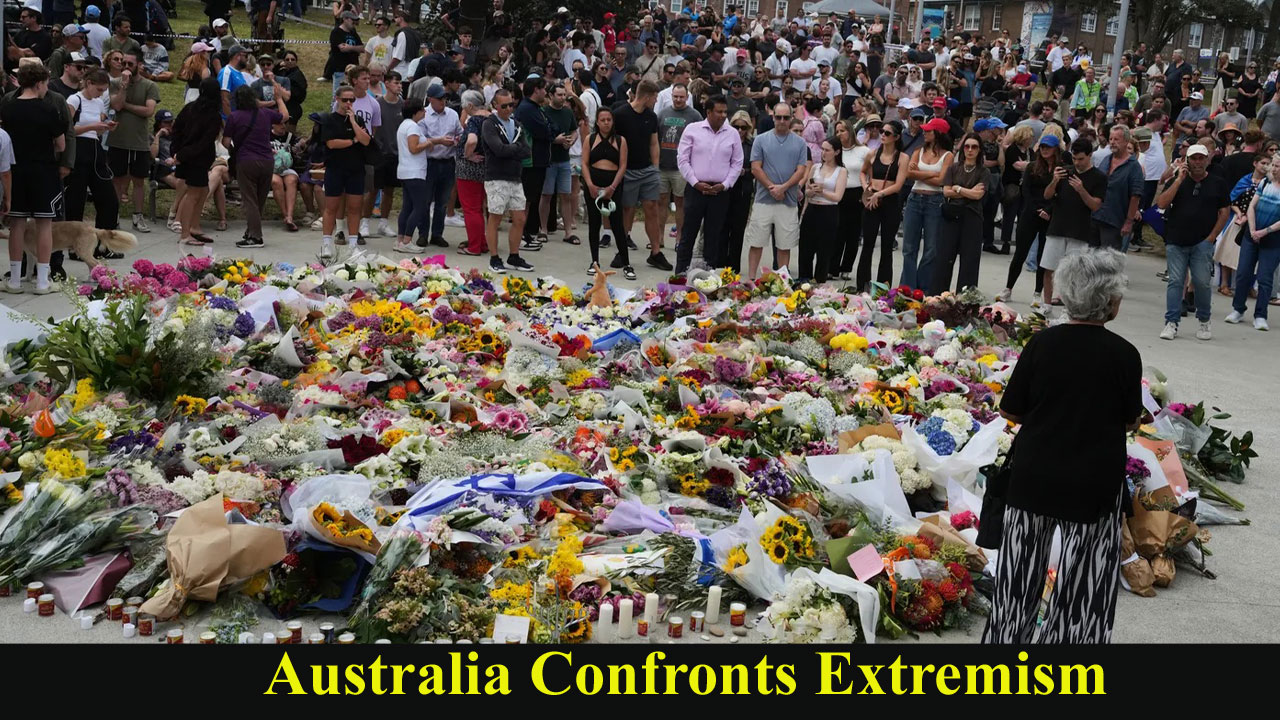
As investigators continue to clarify the attacker’s motivations, the Bondi Massacre has already reshaped public discourse. Questions of ideology, mental health, online radicalisation, and preventive policing now sit at the center of a national conversation that extends beyond the immediate facts of the case.
Understanding the Nature of the Attack
Authorities have approached the investigation with caution, emphasizing evidence-based conclusions rather than speculation. Early assessments suggest the attack does not fit neatly into traditional categories of organized terrorism, underscoring the complexity of contemporary violence.
The Bondi Massacre reflects a broader global pattern in which lone actors, often operating without formal organizational ties, carry out acts of extreme violence. Such attacks challenge conventional counterterrorism frameworks that were largely designed to disrupt networks rather than individuals.
Key Characteristics of Contemporary Attacks
- Limited or no direct affiliation with organized extremist groups
- Rapid radicalisation or personal grievance amplification
- Use of easily accessible weapons
- Selection of everyday public spaces
These dynamics complicate early detection and intervention, placing pressure on intelligence agencies and community-based prevention strategies alike.
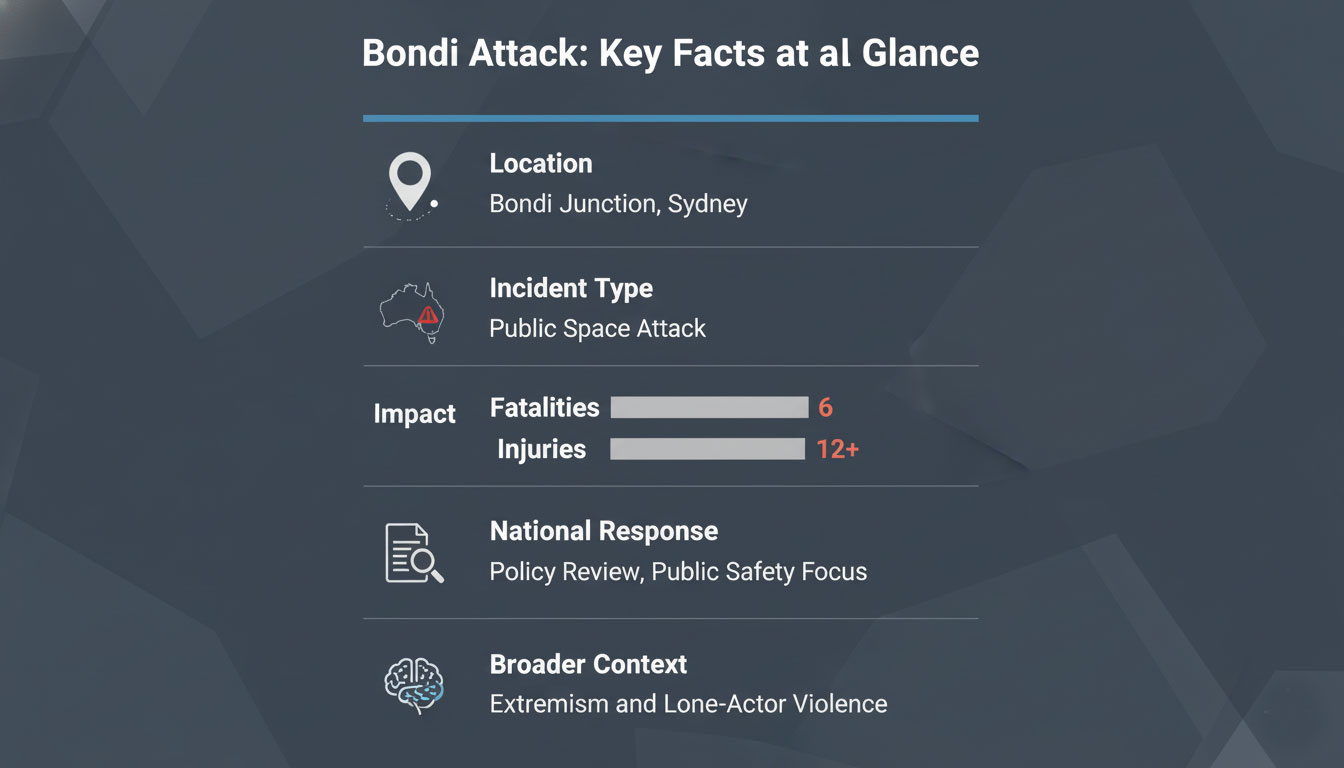
Key Information Table On : Bondi Attack Overview
| Category | Information |
|---|---|
| Location | Bondi Junction, Sydney |
| Setting | Public commercial area |
| Impact | Multiple fatalities and injuries |
| Suspected Actor | Lone individual |
| National Response | Policy review, public safety debate |
This snapshot illustrates why the Bondi Massacre has resonated so strongly across Australia’s political and social landscape.
Extremism Beyond Traditional Definitions
Australia’s counter-extremism policies have historically focused on ideologically driven threats, particularly those linked to international terrorist organizations. However, the Bondi Massacre has reignited debate about whether current definitions are too narrow for modern realities.
Experts increasingly argue that extremism today often intersects with personal grievance, misogyny, racial hatred, or conspiracy thinking, amplified by digital platforms. These influences may not always produce clear ideological manifestos, yet they can still motivate lethal violence.
The challenge for policymakers lies in balancing civil liberties with early intervention. Expanding surveillance or predictive policing carries ethical and legal risks, even as the public demands stronger safeguards.
The Role of Online Radicalisation
Digital ecosystems have transformed how harmful ideas spread. Social media algorithms, private messaging platforms, and fringe online communities can accelerate radicalisation processes that once unfolded over years.
In the wake of the Bondi Massacre, renewed attention has turned to:
- Online echo chambers that normalize violence
- Algorithmic amplification of extreme content
- The difficulty of monitoring encrypted communications
Australia has already enacted legislation aimed at holding platforms accountable for hosting harmful material. Yet enforcement remains uneven, particularly when content circulates rapidly across borders.
Public Safety and Urban Vulnerability
The attack has exposed the vulnerability of open, democratic spaces. Shopping centers, transport hubs, and cultural venues are designed for accessibility, not fortification.
Following the Bondi Massacre, state governments have begun reviewing:
- Visible policing strategies
- Emergency response coordination
- Public awareness and evacuation protocols
While increased security presence can reassure the public, experts warn against measures that create fear or erode social trust. Australia’s response, they argue, must reinforce resilience rather than normalize a sense of permanent threat.
Mental Health and Violence: A Delicate Debate
Public discussion after the Bondi Massacre has inevitably touched on mental health, though professionals caution against simplistic associations. The vast majority of people living with mental illness are not violent, and conflating the two risks deepening stigma.
Nonetheless, gaps in mental health care access, crisis intervention, and follow-up support remain a concern. The tragedy has renewed calls for:
- Improved crisis response systems
- Better coordination between health services and law enforcement
- Early support mechanisms for individuals showing signs of distress
Addressing these gaps requires sustained investment rather than reactive policy shifts.
Political Responses and Policy Reassessment
Australia’s political leaders have emphasized unity and restraint, resisting the temptation to rush through sweeping legislative changes. Still, the Bondi Massacre has prompted bipartisan discussions on whether existing frameworks adequately address emerging threats.
Policy areas under review include:
- Counter-extremism funding priorities
- Information-sharing protocols between agencies
- Community-based prevention programs
The challenge lies in crafting responses that are proportionate, effective, and grounded in evidence, rather than driven by public pressure alone.
Community Impact and Social Cohesion
Beyond policy, the attack has had a profound emotional impact on communities. Vigils, memorials, and public gatherings have highlighted collective grief, while also reinforcing a commitment to social cohesion.
Community leaders have stressed that the Bondi Massacre should not become a catalyst for division or scapegoating. Australia’s multicultural fabric, they argue, remains a source of strength rather than vulnerability.
Grassroots initiatives promoting dialogue, inclusion, and mental health awareness have gained renewed attention, reflecting a belief that prevention begins at the community level.
Media Responsibility in the Aftermath
Coverage of mass violence carries ethical responsibilities. Sensationalism can amplify fear or inadvertently glorify perpetrators. Australian media outlets have largely adhered to guidelines that prioritize victims, context, and verified information.
The Bondi Massacre has reinforced calls for:
- Responsible reporting standards
- Avoidance of perpetrator notoriety
- Greater focus on systemic issues rather than individual pathology
Such approaches align with international best practices aimed at reducing copycat incidents.

Australia in a Global Context
While mass-casualty attacks remain relatively rare in Australia compared to some regions, global trends suggest no society is immune. The Bondi Massacre places Australia within a wider international conversation about lone-actor violence and societal resilience.
Comparative studies indicate that prevention is most effective when security measures are paired with:
- Strong social services
- Inclusive political discourse
- Media literacy and digital regulation
Australia’s response will be closely watched by other democracies facing similar challenges.
Lessons and Long-Term Implications
The true impact of the Bondi Massacre will unfold over time. Beyond immediate policy reviews, the incident raises deeper questions about how societies identify risk, care for vulnerable individuals, and maintain open public spaces without fear.
Long-term responses are likely to focus on:
- Strengthening early-intervention systems
- Enhancing digital accountability
- Reinforcing community resilience
These measures require patience, funding, and political consensus, qualities often tested in the aftermath of tragedy.
The Bondi Massacre stands as a stark reminder that even stable, open societies must continually adapt to evolving forms of violence. Australia’s response so far has emphasized evidence, unity, and restraint, resisting simplistic narratives or reactionary measures.
As investigations continue and policy debates evolve, the central challenge remains clear: how to protect public safety while preserving the openness and social trust that define democratic life. The answer will shape not only Australia’s security framework, but also its national identity in an era of uncertainty.


