
Coca Cola Sustainable Packaging Marks a Major Shift in 2025 Strategy. In 2025, the global beverage industry finds itself at a pivotal crossroads. Pressure from environmental regulators, consumers, and sustainability advocates has pushed multinational corporations to rethink the materials used to transport and display their products. Against this backdrop, Coca Cola HBC has introduced its latest initiative to cut plastic waste—an ambitious move involving a full transition from shrink-wrap plastics to recyclable cardboard handles for its large beverage multipacks. The initiative, branded Lift Up, is currently being tested in Austria and is already drawing international attention from sustainability experts and industry observers alike. As part of this push, the corporation has linked its latest pilot project to a broader vision of reducing dependence on fossil-fuel-based plastics, with plans that could reshape not only its operations but also industry standards across Europe.
The company’s decision sits squarely within the global conversation about waste reduction, carbon emissions, and the environmental impact of consumer-packaged goods. Coca Cola HBC one of the largest bottlers in the Coca-Cola system has emphasized that the new design reflects its long-term commitments to circular packaging and its stated goal of reducing emissions across its supply chain. It is within this evolving landscape that Coca Cola Sustainable Packaging becomes more than a corporate tagline: it represents a defining shift in the beverage industry’s environmental strategy.
Inside the Lift Up Packaging System
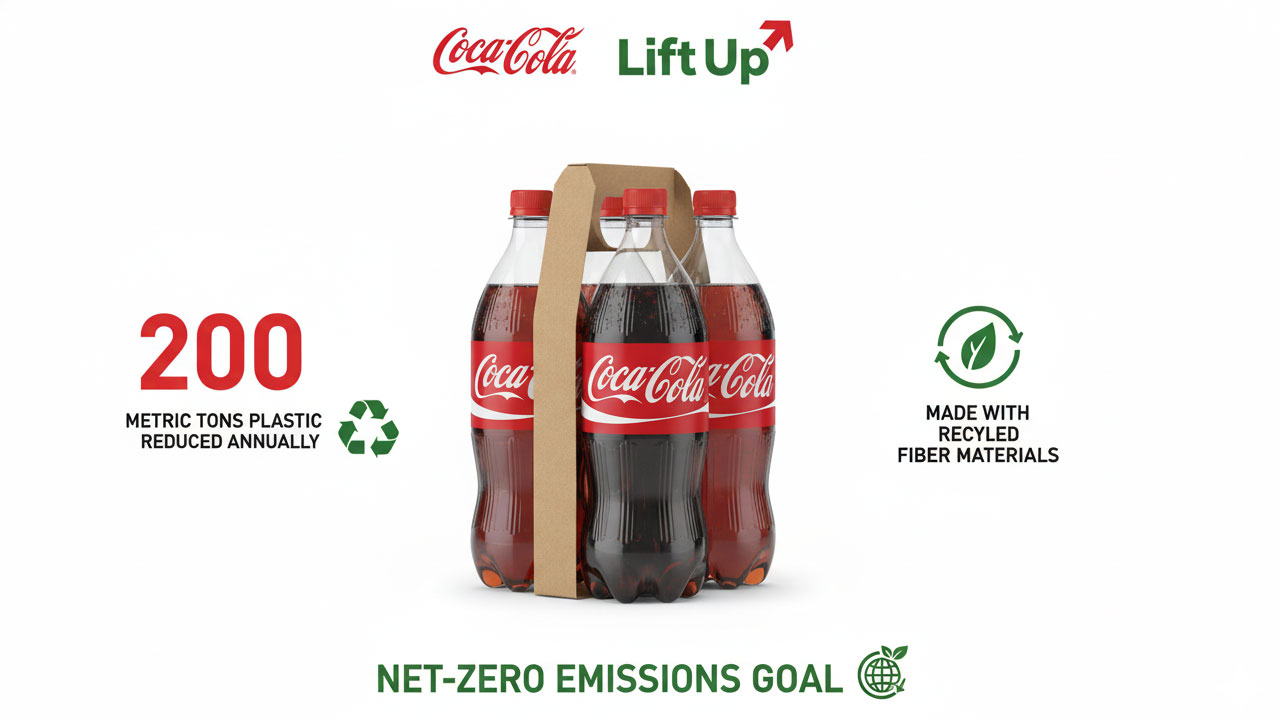
Coca Cola HBC’s Lift Up handle system is designed as a direct replacement for traditional shrink-wrap plastic commonly used for large soda multipacks, particularly for 1.5-liter bottles. Instead of bundling bottles in tight plastic film, the new mechanism uses a cardboard handle that can hold multipacks securely while remaining fully recyclable. This innovation has emerged through a multi-year collaboration with DS Smith, a leader in sustainable paper-based packaging products, and Krones, a leading beverage manufacturing technology firm. According to estimates provided by Coca Cola HBC, the transition from shrink-wrap to a cardboard Lift Up handle could eliminate roughly 200 metric tons of plastic annually from this segment alone. Although this figure represents only a fraction of the company’s overall packaging volume, the symbolic impact is considerable—particularly at a time when environmental advocates are calling for transformative shifts in how multinational brands package beverages.
Collaboration With Sustainability Partners
The partnership between Coca Cola HBC, DS Smith, and Krones underscores a broader trend of cross-industry collaboration aimed at accelerating environmental innovation. DS Smith brings advanced experience in fiber-based engineering, while Krones supports the adaptation of high-speed manufacturing lines capable of managing new materials.
These joint efforts reflect the beverage industry’s increasing need for scalable solutions that maintain efficiency while reducing environmental harm. As beverage manufacturers adopt new standards, designs must not only enhance sustainability but also withstand the operational demands of automated bottling facilities, international distribution networks, and consumer handling.
The significance of Coca Cola Sustainable Packaging becomes more compelling when placed against global expectations for corporate accountability. Regulators across the European Union have strengthened rules surrounding extended producer responsibility (EPR), placing greater obligations on brands to ensure recyclable packaging and reduce virgin plastic use. Coca Cola HBC’s Lift Up test aligns with these expectations and positions the company as an early mover among beverage producers adapting to a changing regulatory landscape.
How the New Packaging Functions
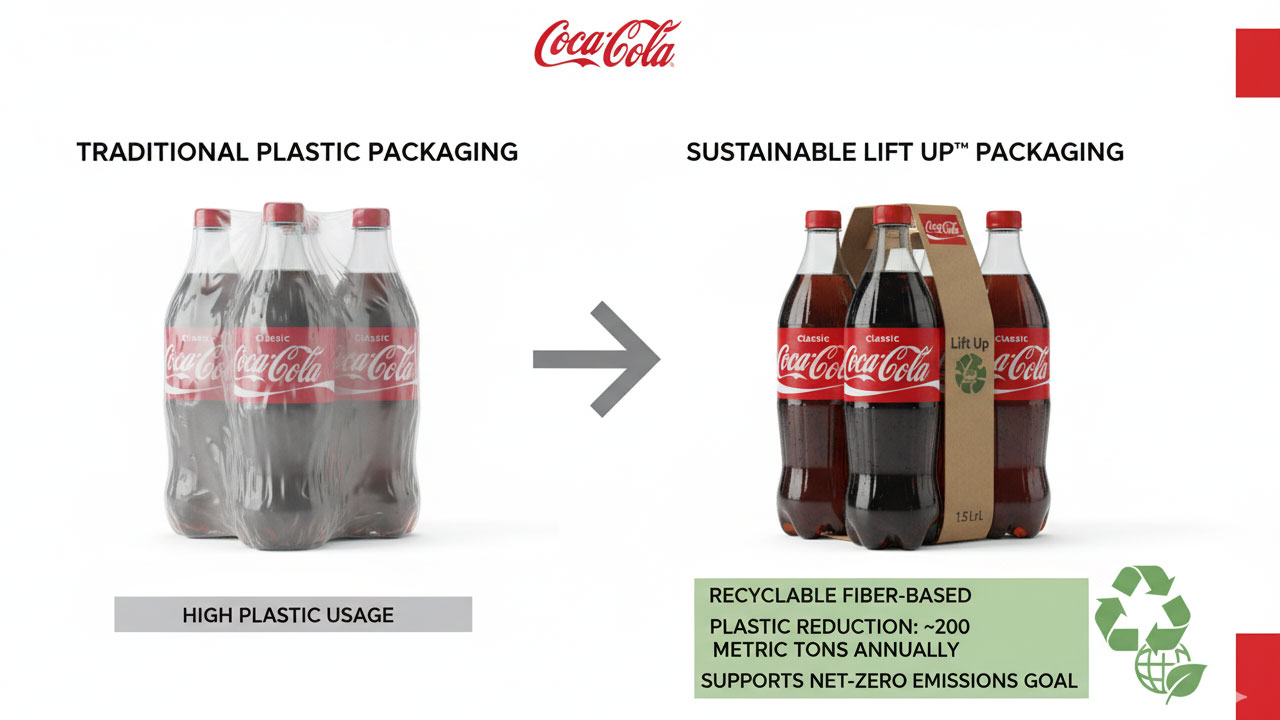
Traditional shrink-wrap plastic provides flexibility, durability, and cost efficiency. However, its environmental drawbacks are well documented. Shrink-wrap is difficult to recycle, has limited reuse potential, and contributes substantially to microplastic pollution when improperly disposed of. By contrast, fiber-based handles and cardboard systems offer advantages in recyclability, biodegradability, and consumer perception.
Structural Design and Material Composition
The Lift Up handle is engineered entirely from recyclable cardboard. Its structure distributes weight evenly across the pack, allowing consumers to transport multipacks with ease. The handle attaches directly to the bottles, minimizing additional material while maximizing structural integrity. Coca Cola HBC has also introduced wraparound labels made from recyclable fibers, reducing the dependence on plastic-based label films typically used in beverage branding.
Together, the Lift Up handle and wraparound labeling form a unified system that reduces the total volume of plastic packaging in each multipack. This system presents an integrated approach to sustainability, acknowledging that meaningful environmental progress requires redesigning packaging at multiple touchpoints.
Key Information Table On Coca Cola’s Lift Up Packaging Pilot
| Category | Details |
|---|---|
| Initiative Name | Lift Up Handle Packaging |
| Company | Coca Cola HBC |
| Pilot Market | Austria |
| Packaging Type | Recyclable cardboard handle replacing plastic shrink wrap |
| Plastic Reduction Estimate | ~200 metric tons annually |
| Supporting Partners | DS Smith, Krones |
| Environmental Goal | Net-zero emissions by 2040 |
| Key Materials | Fiber-based cardboard; recyclable wraparound labels |
| Industry Impact | Potential shift in beverage multipack standards across Europe |
The inclusion of this pilot study highlights why Coca Cola Sustainable Packaging remains a central topic in conversations around corporate accountability and environmental stewardship.
Industry Reactions and Environmental Significance
Coca Cola HBC’s announcement has appeared in major international business outlets, including Reuters, as global attention to corporate sustainability intensifies. Environmental groups have responded favorably to the move, noting that fiber-based alternatives represent a viable pathway toward measurable reductions in plastic waste. While the success of the Lift Up handle will depend on operational efficiency and consumer behavior, experts have pointed to the broader symbolic power of a Coca-Cola system bottler making such a shift.
Recyclability and Consumer Behavior
A recurring challenge within sustainable packaging initiatives lies in consumer handling and recycling habits. Fiber materials are generally easier to process within municipal recycling systems, but the environmental benefits of the Lift Up system depend on proper disposal. Retailers across Europe have emphasized the need for clear recycling guidance, reinforcing the notion that sustainable packaging requires both corporate innovation and public participation.
The Forest Stewardship Council (FSC) has praised Coca Cola HBC’s commitment to responsible sourcing. The organization highlights the importance of certified fiber materials in ensuring that increased demand for cardboard does not lead to unsustainable forestry practices. Through this lens, Coca Cola Sustainable Packaging encompasses not just packaging redesign but also the sourcing and lifecycle management of raw materials.
Regulatory Pressure and Market Transformation
Packaging reform has become a central theme in European environmental policy. Several EU directives—including the Single-Use Plastics Directive—place strict requirements on manufacturers to reduce plastic consumption. These policies have accelerated innovation across the beverage market and intensified pressure on industry leaders to adopt alternatives.
Coca Cola HBC’s Lift Up initiative demonstrates a strategic response to both consumer expectations and regulatory momentum. If the Austrian pilot proves successful, Coca Cola HBC may expand the system across additional European markets, fundamentally altering how large soda multipacks are presented in retail environments.
Potential Industry Adaptation
Industry experts suggest that Coca Cola HBC’s decision could motivate competitors to accelerate their own transitions toward fiber-based packaging. Large beverage producers often adopt parallel strategies in response to competitive pressures and evolving consumer preferences. Should Coca Cola HBC scale the Lift Up handle across multiple regions, it may establish a new norm in multipack packaging for the entire sector.
This shift aligns with broader trends showing increased investment in biodegradable and compostable materials, paper rings, and hybrid packaging systems across the beverage landscape. The success of Coca Cola Sustainable Packaging could therefore signal one of the early tipping points in the move away from shrink-wrap plastics.
The Future of Coca Cola’s Environmental Vision
Coca Cola HBC’s long-term objective is to achieve net-zero emissions by 2040. Packaging plays a significant role in this effort. By reducing plastic use, lowering reliance on fossil-fuel inputs, and integrating recyclable materials, the company aims to reduce the overall carbon footprint associated with its products.
The company’s representative, Marcel Martin, noted that investments in sustainable packaging remain essential to its corporate strategy. He added that the company will continue to allocate resources toward packaging redesign, including innovations in manufacturing efficiency, supply chain logistics, and plastic reduction.
Operational and Economic Implications
Although fiber-based solutions are generally more environmentally friendly, they may present operational challenges, including higher initial production costs, adjustments to automated lines, and variations in material durability. Coca Cola HBC has acknowledged these complexities but maintains that long-term gains—both environmental and reputational justify the investment.
Industry analysts argue that cost differences between plastic and fiber will diminish as global demand for sustainable packaging rises and production capacities scale. Companies that transition early may gain competitive advantages in brand perception, regulatory preparedness, and supply chain resilience.
A Defining Moment for Beverage Sustainability
Coca Cola HBC’s Lift Up handle pilot represents an important chapter in the evolution of global beverage packaging. The company’s shift toward fiber-based materials reflects larger societal demands for environmentally conscious practices and the rising urgency surrounding climate change mitigation.
In this context, Coca Cola Sustainable Packaging stands as a benchmark for both corporate responsibility and industry-wide transformation. As the Austrian test unfolds, the global beverage market will be watching closely. If successful, the Lift Up handle could inspire a wave of packaging reforms across Europe and beyond, shaping how consumers interact with beverages and how industries approach ecology-driven innovation.


