
Google’s Nano Banana Pro AI Limits Free Access, Transforming Digital Art Creation Google’s latest AI model, Nano Banana Pro, has captured global attention for its capacity to produce photorealistic and highly stylized images. Yet, the tech giant’s decision to restrict free access has sparked debate across creative communities, highlighting the growing tension between cutting-edge AI innovation and the economic realities of scaling advanced machine learning models.
Originally released as part of Google’s Gemini Pro suite, Nano Banana Pro has been lauded for its unprecedented versatility. Users can replicate photographic styles from past decades, isolate products for e-commerce, and manipulate lighting and scene composition while preserving subject likeness a level of control previously available only in professional design software.
The rapid surge in popularity, driven by viral social media showcases, has pushed Google to implement strict limits for non-paying users, a move reflecting both server load concerns and the strategic monetization of premium AI tools.
Capabilities That Set Nano Banana Pro Apart
The Gemini Pro platform, powered by Nano Banana Pro, is more than a typical image generator. It functions as a comprehensive digital art studio capable of producing images indistinguishable from professional photography. Its unique features include:
- Photographic Style Recreation: From 1950s film aesthetics to contemporary high-definition photography, Nano Banana Pro adapts lighting, texture, and color grading with high fidelity.
- Advanced Scene Editing: Users can modify backgrounds, lighting, and even time-of-day effects without affecting the subject.
- Text-to-Image Layouts: The AI can transform textual descriptions into complex magazine spreads or product catalog layouts.
- Product Isolation: Essential for e-commerce, the tool allows precise removal or repositioning of objects within a scene.
These capabilities have made Nano Banana Pro particularly appealing to professional designers, content creators, and marketing teams seeking efficiency and quality without extensive manual editing.Why Free Users Now Face Restrictions
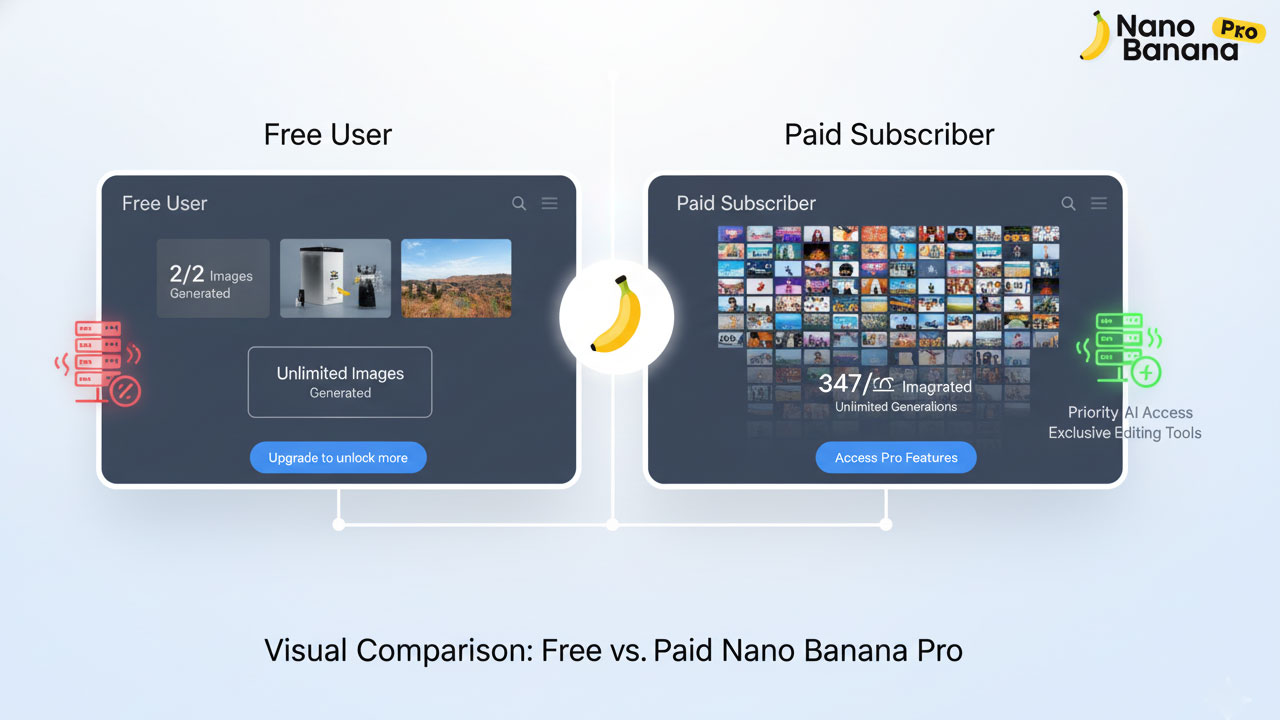
Initially, Google offered relatively generous access for free accounts, allowing multiple daily image generations. However, in recent weeks, free users have reported a sharp reduction in availability—now capped at just two images per day.
According to Associated Press reporting, these limits are dynamic and fluctuate depending on server demand. Google has clarified that “basic access” is now standard for non-subscribers, a measure intended to manage computational costs and server congestion.“Generating images at this level of fidelity consumes considerable processing power,” a Google spokesperson said. “As demand grows, maintaining free unlimited access for the most advanced models is no longer feasible.”
The restriction highlights a fundamental challenge for AI developers: balancing accessibility with the operational costs of delivering high-quality generative AI services.

The Growing Divide Between Free and Paid Plans
For subscribers to Gemini Advanced, the experience contrasts sharply with free users. Paid accounts can generate hundreds of images daily without interruption, secure stable server access, and utilize additional professional features designed for large-scale production.
This differentiation effectively creates a two-tier system:
- Hobbyists and casual users face hard caps and unpredictable availability.
- Professional users are incentivized to adopt subscription plans to maintain workflow continuity.
The move underscores Google’s broader strategy to monetize AI creativity while sustaining the infrastructure needed for high-end generative models like Nano Banana Pro.
More: How to Watch The Graham Norton Show Online?
Implications for Creative Industries
The restriction of free access to Nano Banana Pro has broader implications for the creative economy. Digital artists, marketing professionals, and content creators who previously relied on free access now confront new financial decisions. Some smaller studios may be forced to explore alternative tools or adjust workflows to accommodate limited daily outputs.
Meanwhile, the AI landscape continues to evolve rapidly. Google’s competitors, including OpenAI and Anthropic, are also grappling with similar constraints, highlighting a broader industry trend: advanced AI creativity is increasingly positioned as a premium service.“The era of unlimited free access to high-end AI tools is drawing to a close,” noted a digital art analyst. “The technology has matured, and the operational cost of running these models is significant. Subscription-based access is now the logical model for sustainability.”
Understanding the Technology Behind Nano Banana Pro
At its core, Nano Banana Pro leverages advanced machine learning techniques and massive training datasets to generate images. Its capabilities include semantic understanding of text prompts, high-resolution image synthesis, and adaptive style transfer.
Key technological innovations include: Nano Banana Pro AI Limits Free Access
- Generative Adversarial Networks (GANs): Enhances photorealism and stylistic fidelity.
- Transformer Architectures: Improves context understanding for text-to-image conversion.
- High-Performance GPU Clusters: Essential for rendering complex images in real-time.
These technologies collectively enable a level of creative flexibility that positions Nano Banana Pro at the forefront of AI-powered art.
Key Information Table On Nano Banana Pro
| Feature | Description | Availability |
|---|---|---|
| Model Name | Nano Banana Pro | Gemini Pro Suite |
| Free Image Generation | 2 images/day | Free users only |
| Paid Image Generation | Hundreds/day | Gemini Advanced subscribers |
| Photographic Style Recreation | Yes | All users |
| Product Isolation for E-Commerce | Yes | All users |
| Text-to-Image Layouts | Yes | All users |
| Server Load Impact | High | Paid users prioritized |
| Pricing Model | Subscription-based | Gemini Advanced plan |
The Future of AI-Generated Art
The launch of Nano Banana Pro demonstrates the growing sophistication of AI in creative workflows. Yet, it also illustrates the challenges of providing equitable access to such powerful tools. As subscription models solidify, industry experts anticipate a shift in how creative professionals plan their projects, with AI tools becoming essential yet monetized resources.
For Google, balancing innovation, accessibility, and profitability remains a delicate act. Nano Banana Pro’s success highlights both the potential and the cost of cutting-edge AI, a dynamic that will likely influence the broader trajectory of digital creativity for years to come.
Nano Banana Pro represents a landmark in AI-assisted artistry, merging photorealistic precision with unparalleled creative flexibility. However, its newfound scarcity for free users signals a pivotal moment in the monetization of AI technologies. For creative professionals, the choice is clear: adapt to subscription-based access or adjust workflows to the constraints of basic accounts. As Google navigates server demands and operational costs, Nano Banana Pro stands as both a technological triumph and a case study in the economics of AI.


