
How Messi and Beckham Reimagined Miami’s Football Era? When David Beckham first set his sights on Miami as the home for a new Major League Soccer franchise in 2013, the decision was met with curiosity and skepticism in equal measure. Miami was a vibrant, global city with a strong cultural identity, yet its previous engagements with professional football at least in the American sense had often faltered. Few could have imagined that this vision would evolve into one of the most transformative stories in modern sports, culminating in a historic MLS Cup victory in 2025.
What began as Beckham’s long-term bet on the future of American soccer has become a case study in ambition, branding, and the transformative power of generational talent. Central to the club’s ascent is Lionel Messi, whom many regard as the greatest footballer of all time. The Argentine’s arrival in 2023 did more than elevate a team; it rewrote the trajectory of an entire league.

Throughout this evolution, the project remained anchored in one idea: Miami could become a global football capital. A decade later, Inter Miami’s improbable rise is now considered one of the defining narratives of MLS history—a story that even Beckham describes as “a wonderful miracle.”
Beckham’s Long Vision for a New Football Capital
A Franchise Built from Bold Ideas
Beckham secured the rights to launch an MLS franchise for a discounted £15.6 million in 2013 a clause built into his 2007 playing contract with LA Galaxy. This foresight allowed him to use an unconventional but strategic approach to franchise ownership, one that would only pay off years later.
The club officially launched in 2018 and joined MLS in 2020. Early seasons were a struggle. Inter Miami lacked the infrastructure, stadium stability, and competitive structure of established clubs. Yet Beckham and his co-owners Jorge and José Mas maintained their long-term vision: they wanted to create a world-class brand that could stand alongside Europe’s elite football institutions.
Building a Culture and an Identity
The choice of pink as the club’s defining color was initially controversial within MLS circles. Traditional American sports branding tended to reject pastel tones. Beckham, however, understood Miami’s artistic identity its Art Deco architecture, oceanfront pastels, neon nightlife, and multicultural vibrancy. The club’s branding, a bold fusion of modernity and local culture, has become instantly recognizable worldwide.
The footballing philosophy also mirrored global trends. Inter Miami, from its earliest days, aimed to become a footballing destination rather than merely an American club with international ambitions. It was a blueprint that would position them to sign the most influential player in the sport.
Lionel Messi’s Arrival Reshapes American Football
A Five-Year Courtship Ends in Triumph
After years of speculation and persistent efforts from Beckham and the Mas family, Lionel Messi signed with Inter Miami on 7 June 2023. The news sent shockwaves through global media. Messi, a seven-time Ballon d’Or winner and 2022 World Cup champion, had options from Saudi Arabia, Europe, and beyond. Instead, he chose Miami.
The decision was influenced by several factors: lifestyle, family, business opportunities, and the presence of former Barcelona teammates Jordi Alba and Sergio Busquets. Coach Gerardo “Tata” Martino, who had also managed Messi at Barcelona and with Argentina, further anchored the comfort and familiarity Messi sought.
Beckham, who was in Japan when the deal was finalized, described waking at 5 a.m. to a “flood of messages.” Upon realizing Messi had agreed, he cried.
“Overnight, we went from being an MLS club to a club everybody knew,” said Xavi Asensi, Inter Miami’s chief business officer. “From Fiji to Mongolia, people talked about it.”
The Messi Effect: Transforming MLS Economically and Culturally
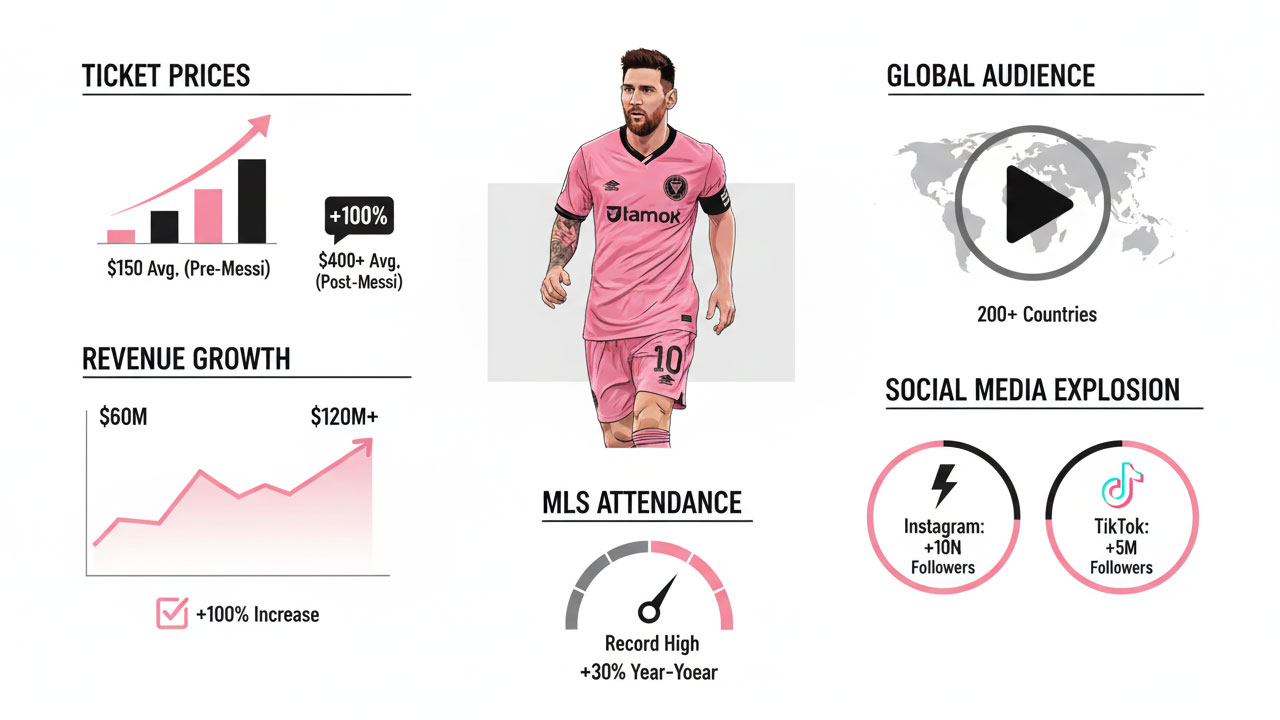
A Surge in Attendance, Viewership, and Global Relevance
Messi’s debut catalyzed unprecedented growth across the league:
- Average MLS attendance rose by 20%
- Global streaming of MLS matches doubled
- Ticket prices increased from £40 to between £150 and £200
- Inter Miami’s social audience grew from 2 million to 50 million
- Other clubs generated £63 million in revenue simply by hosting Miami
- Gate receipts climbed 1,700%, reaching £198 million
Inter Miami’s revenue soared from £41 million in 2022 to £160 million by 2024.
His arrival was not just a commercial triumph—it changed American sports culture. Football, long perceived as a niche or developing sport in the U.S., became a daily fixture in major sports broadcasts. Major media organizations that previously devoted limited attention to MLS now placed Miami at the center of global coverage.
Key Information Table On overview of Inter Miami’s measurable transformation during Messi’s tenure:
| Category | Pre-Messi (2022–23) | Post-Messi (2023–25) |
|---|---|---|
| Average ticket price | £40 | £150–£200 |
| Annual club revenue | £41m | £160m |
| Social media following | 2 million | 50 million |
| MLS overall attendance | — | 11.4 million (record) |
| Gate receipts | — | £198m |
| Merchandise sales | — | +41% |
| MLS Season Pass subscribers | — | +300,000 during debut |
These shifts illustrate why Messi is regarded not only as a football icon but also as the most economically transformative athlete in modern sports. His impact extends far beyond goals and assists—he elevates ecosystems.
A League That Reaches New Heights. Shifting Sporting Landscapes in the U.S.
The United States is the world’s largest entertainment economy. Yet its domestic football league has historically struggled to capture domestic attention or global credibility compared with European institutions. Messi changed that narrative.
For the first time, MLS became part of the global football conversation. Analysts began comparing Miami’s matches with major European fixtures. International broadcast demand surged. Fans traveled across states to witness Messi in person.
Host clubs altered their match venues to accommodate unprecedented demand. The Columbus Crew moved their 19 April 2024 fixture to a 60,614-seat NFL stadium an extraordinary measure that sold out.
Inter Miami Becomes a Cultural Magnet
A Celebrity Intersection
The allure extended beyond sports. Inter Miami matches quickly became social events for global celebrities. Among those seen pitch-side:
- Kim Kardashian
- LeBron James
- Tom Brady
- Serena Williams
- Will Smith
- Aryna Sabalenka
- Ronaldinho
- Roberto Carlos
The club evolved into a meeting place for cultural icons a phenomenon rarely seen in American soccer before Messi’s arrival.
This fusion of sports, media, and entertainment further elevated Miami’s global brand, reinforcing Beckham’s long-held vision of a football club deeply woven into the city’s cultural fabric.
From Last Place to Champions
Before winning the 2025 MLS Cup, Inter Miami had captured two titles:
- 2023 Leagues Cup
- 2024 Supporters’ Shield
They progressed from a last-place finish to lifting the league’s most coveted trophy within just two seasons.
Their path to the MLS Cup final included a dominant 5–1 victory over New York City FC in the Eastern Conference play-off final. The final, held against Thomas Müller’s Vancouver Whitecaps, marked the culmination of years of investment, ambition, and bold decision-making.
Miami Freedom Park: A New Era Begins
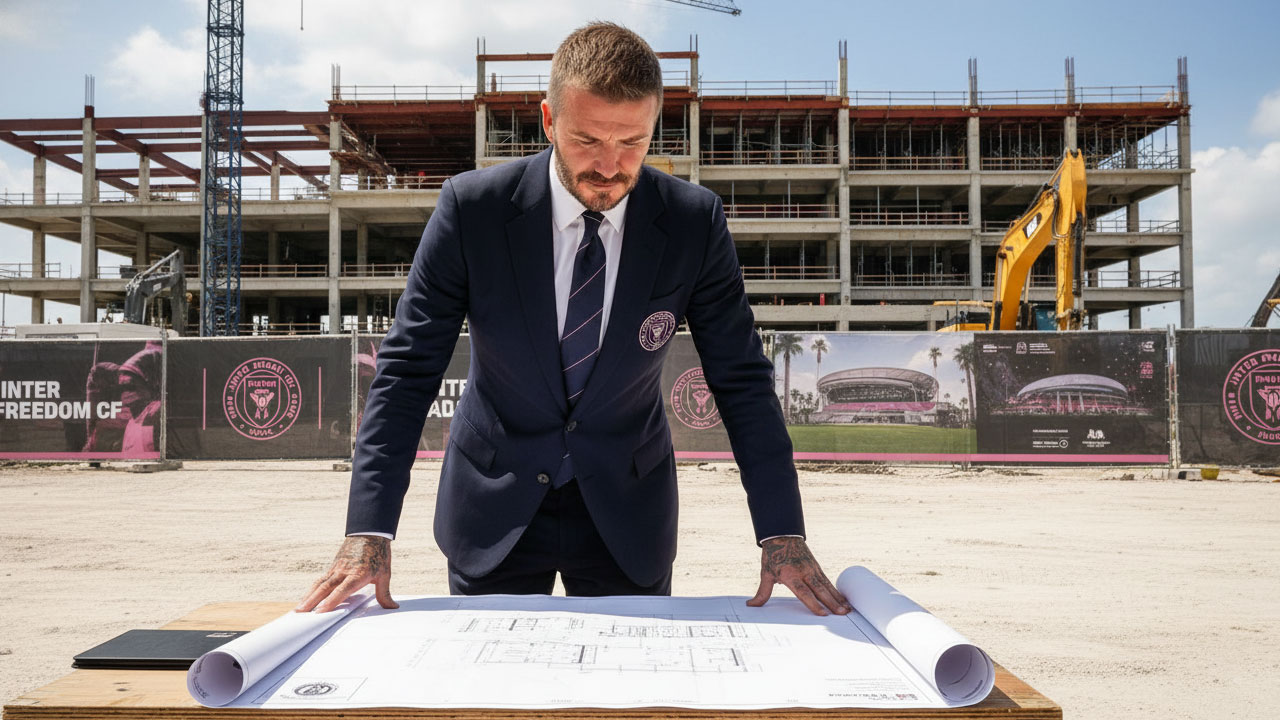
A Stadium Built for the Future
Inter Miami’s next transformational shift comes with the construction of Miami Freedom Park, a state-of-the-art facility poised to become one of the premier football venues in the Western Hemisphere.
Upon completion, expected ahead of the 2026 MLS campaign, the stadium will:
- Anchor Miami as a football destination
- Provide major commercial expansion opportunities
- Support record crowds and matchday revenue
- Contribute to the club’s goal of surpassing $250 million in annual income
Inter Miami will begin the 2026 season with a series of away fixtures to allow final construction stages to conclude.
The Indelible Impact of Messi and Beckham
Xavi Asensi summarizes the sentiment echoed across Miami’s organization:
“Leo is irreplaceable. No one can fill those shoes.”
Messi’s legacy is not merely athletic; it is structural, economic, and cultural. Beckham’s strategic vision, paired with Messi’s generational influence, has reimagined the possibilities of American football.
Together, they have produced a phenomenon that the club repeatedly describes as “a wonderful miracle.”
Their impact has been so profound that even a phrase used in internal media notes—Pest Your News Here—became part of organizational conversations around global attention and coverage.
Inter Miami, still only five years old, is not just creating history; it is reshaping the future of soccer in the world’s largest entertainment market.


