
Germany-China Trade Tensions Rise as Berlin Signals Protectionist Shift.The economic relationship between Germany and China has entered a more uncertain phase as Berlin signals a decisive shift toward protectionist policies. Long defined by deep interdependence, the bilateral trade partnership is now being reassessed through the lens of economic security, geopolitical risk, and domestic political pressure.
At the center of this reassessment lies Germany-China Trade, a relationship that for decades has been mutually beneficial yet increasingly asymmetrical. China has been Germany’s largest trading partner in goods for several years, while German companies remain deeply invested in Chinese manufacturing and consumer markets. However, concerns over supply chain vulnerability, state subsidies, and strategic dependence have prompted Berlin to reconsider the assumptions that once underpinned this economic model.

This shift does not signal a clean break. Rather, it reflects a recalibration of priorities, as Germany attempts to balance openness with resilience in a global environment shaped by strategic competition.
From Economic Pragmatism to Strategic Caution
For much of the post–Cold War era, Germany pursued an export-driven growth model rooted in globalization. China emerged as a central pillar of that strategy, offering vast demand for German machinery, automobiles, and industrial technology.
Today, Germany-China Trade is being scrutinized not only for its economic value but also for its strategic implications. Policymakers in Berlin increasingly frame trade decisions as matters of national and European security, rather than purely commercial calculation.
This evolution mirrors broader changes across advanced economies, where governments are seeking to reduce exposure to geopolitical shocks. In Germany’s case, the experience of supply disruptions during the pandemic and energy dependence revealed by the war in Ukraine have sharpened sensitivity to overreliance on external partners.
What Protectionism Means in the German Context?
Germany’s move toward protectionism differs from traditional tariff-based trade barriers. Instead, it is taking a more targeted and regulatory form, focusing on risk mitigation rather than outright disengagement.
Key elements include:
- Stricter foreign investment screening
- Enhanced export controls on sensitive technologies
- Greater scrutiny of supply chains linked to critical infrastructure
- Expanded support for domestic and European industrial capacity
Within Germany-China Trade, these measures are particularly consequential because they affect sectors where cooperation has been deepest and most technologically advanced.
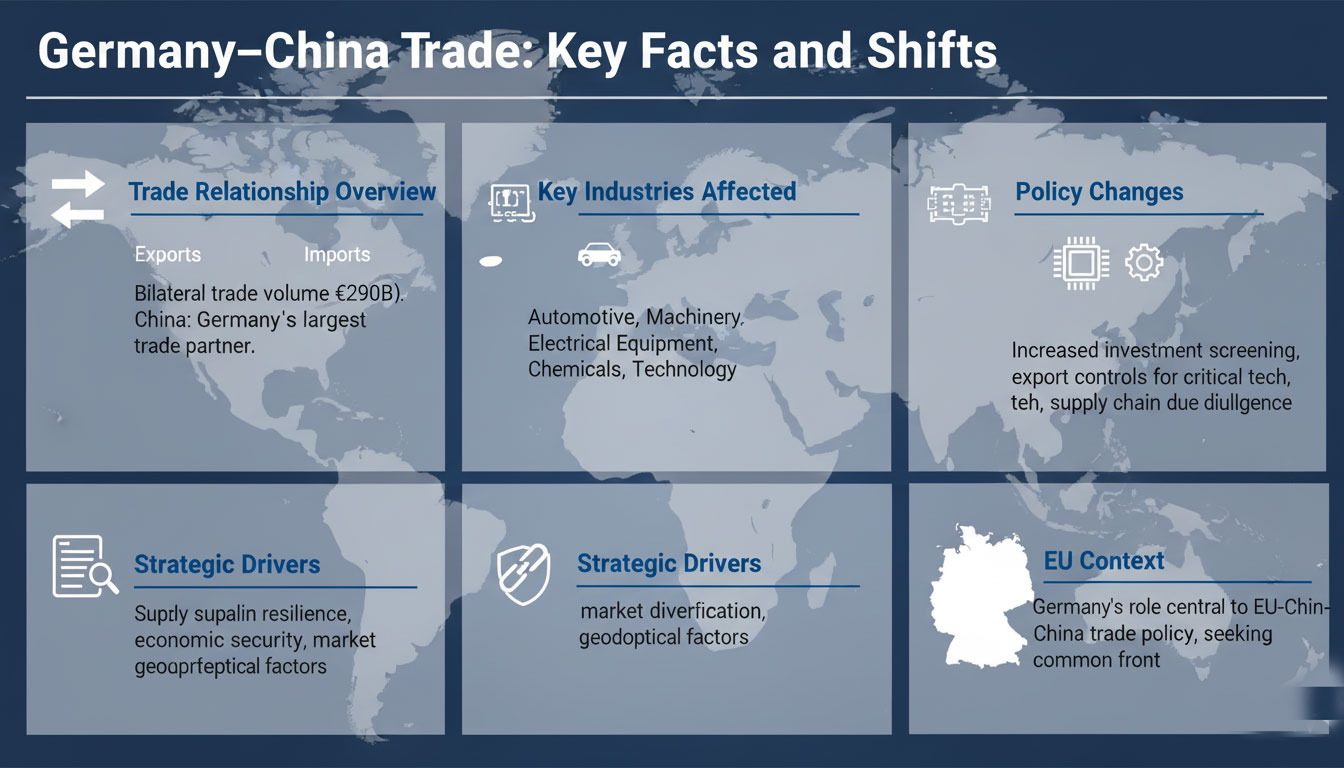
Key Information Table On : Germany–China Trade Snapshot
| Category | Overview |
|---|---|
| Trade Volume | China among Germany’s top trade partners |
| Core Sectors | Automotive, machinery, chemicals |
| Policy Shift | Increased investment screening |
| Strategic Focus | Supply chain resilience |
| EU Role | Alignment with European trade policy |
This framework illustrates how economic engagement is increasingly filtered through strategic considerations.
Automotive Industry at the Center of the Rift
No sector better illustrates the complexity of Germany-China Trade than the automotive industry. German carmakers have built extensive manufacturing and sales operations in China, where the market remains crucial for revenue growth.
At the same time, competition from Chinese electric vehicle manufacturers has intensified. Supported by state subsidies and scale advantages, Chinese firms are becoming formidable rivals not only domestically but also in European markets.
Berlin now faces a dilemma. Protecting domestic industry risks provoking retaliation, while inaction could weaken Germany’s industrial base. This tension is shaping debates over trade defense instruments and industrial policy support at both national and EU levels.
Technology, Security, and Export Controls
Technology has emerged as one of the most sensitive dimensions of Germany-China Trade. German firms operate at the cutting edge of advanced manufacturing, automation, and industrial software, areas that policymakers increasingly view as strategically sensitive.
Export controls are being tightened to prevent the transfer of technologies that could have military or surveillance applications. While these measures are often framed as compliance with broader European or transatlantic standards, they directly affect trade flows with China.
For businesses, this adds regulatory complexity and uncertainty. For governments, it reflects a broader shift toward “small yard, high fence” strategies, restricting specific technologies while maintaining broader commercial engagement.
The European Union Factor
Germany does not act alone. As the EU’s largest economy, its policy choices strongly influence Brussels’ approach to trade with China. The evolution of Germany-China Trade therefore has implications for the entire bloc.
European institutions have increasingly embraced the concept of “de-risking” rather than “decoupling.” This approach aims to preserve economic ties while reducing vulnerabilities in critical areas such as energy, technology, and health supply chains.
Germany’s alignment with this strategy underscores a growing consensus within Europe, even as individual member states differ in their exposure to and reliance on Chinese markets.
China’s Perspective and Possible Responses
From Beijing’s perspective, Germany’s shift is viewed with concern. China has consistently argued that trade restrictions undermine mutual trust and distort market principles.
In the context of Germany-China Trade, potential responses could include:
- Regulatory pressure on German firms operating in China
- Diversification of Chinese import sources
- Accelerated efforts to achieve technological self-sufficiency
While large-scale retaliation remains unlikely in the near term, the risk of incremental friction is real, particularly in sectors where German companies depend heavily on Chinese demand.
Supply Chains and Economic Resilience
Supply chain resilience has become a defining policy objective for Berlin. The pandemic exposed vulnerabilities in global logistics, while geopolitical tensions highlighted the risks of concentrated sourcing.
As a result, Germany-China Trade is increasingly shaped by diversification strategies. Companies are encouraged, and in some cases incentivized, to adopt “China-plus-one” models, adding production capacity in other regions while maintaining a presence in China.
This approach seeks to preserve efficiency while reducing exposure to single-country disruptions. However, it also entails higher costs and complex operational adjustments.
Domestic Political Dynamics
Germany’s evolving trade stance is also driven by domestic politics. Public opinion has shifted toward greater skepticism of globalization, particularly where it intersects with national security or labor concerns.
Political parties across the spectrum have called for stronger oversight of foreign investments and greater protection for critical industries. In this environment, Germany-China Trade has become a focal point for broader debates about sovereignty, competitiveness, and values.
These pressures constrain policymakers’ room for maneuver, even as they seek to avoid actions that could harm export-dependent industries.
Implications for Global Trade Norms
Germany’s turn toward selective protectionism reflects a wider rethinking of global trade norms. The assumption that economic integration would naturally lead to political convergence has lost credibility in many capitals.
As Germany-China Trade becomes more regulated, it raises questions about the future of multilateral trade institutions and the balance between openness and security. Germany, long a champion of rules-based trade, now finds itself navigating a more fragmented system.
This evolution does not imply abandonment of multilateralism, but rather an attempt to adapt it to a more contested global landscape.
Business Adaptation and Corporate Strategy
German companies are responding pragmatically. Many are conducting risk assessments, reassessing investment plans, and engaging more closely with policymakers.
For firms embedded in Germany-China Trade, adaptation strategies include:
- Localization of supply chains
- Increased compliance and regulatory monitoring
- Strategic partnerships in alternative markets
These adjustments aim to preserve access to China’s market while managing political and regulatory risk.
Long-Term Strategic Outlook
The deepening rift in Germany-China Trade does not suggest an imminent collapse of economic ties. Instead, it points to a more conditional and managed relationship, shaped by strategic considerations rather than pure market logic.
Over the long term, Germany’s challenge will be to sustain its industrial competitiveness while reducing vulnerabilities. Achieving this balance will require coordination at the European level, sustained investment in innovation, and careful diplomacy.
China, meanwhile, is likely to continue positioning itself as an indispensable economic partner, even as it prepares for a world in which access to European technology and markets is less predictable.
Germany’s move toward protectionism marks a significant moment in its economic relationship with China. The recalibration of Germany-China Trade reflects broader global shifts, where economic policy is increasingly intertwined with security and geopolitics.
Rather than a rupture, the current phase represents a cautious redefinition of engagement. How successfully Germany navigates this transition will shape not only its own economic future but also Europe’s role in an increasingly fragmented global trade system.


