
Despite Opposition, US House Passes Record $901bn Defence Spending Bill. The United States House of Representatives has approved a landmark defence policy bill authorising a record $901 billion in annual military spending, setting the stage for ongoing debates over the scope and oversight of American military commitments. The vote on Wednesday saw 312 lawmakers in favor, while 112 opposed the legislation. The bill has now moved to the Senate for consideration and is widely expected to pass in the coming week.
The proposed spending for the 2026 fiscal year exceeds the Trump administration’s May 2025 request by $8 billion, reflecting a broader congressional consensus to expand military capabilities and improve conditions for service members.
Key Provisions of the National Defense Authorization Act
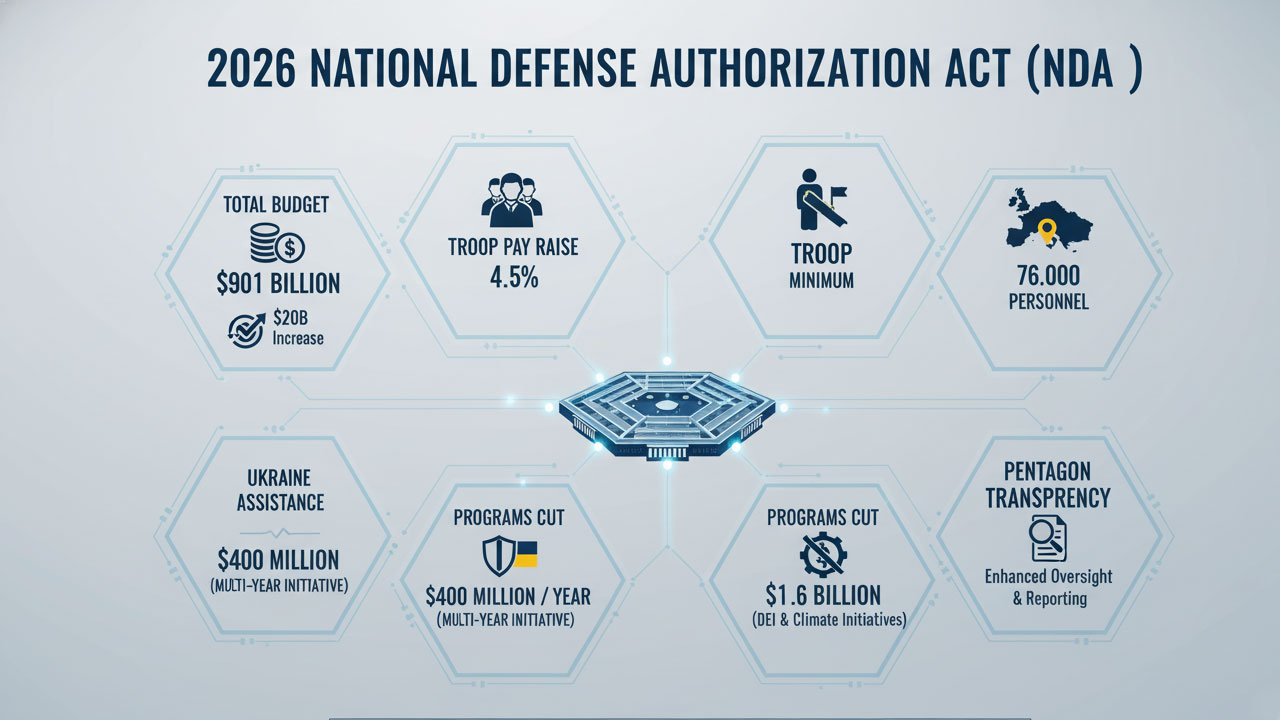
The 3,086-page National Defense Authorization Act (NDAA) contains comprehensive measures designed to modernize U.S. forces and ensure global competitiveness. Provisions include:
- Military acquisitions and modernization to maintain strategic parity with rivals such as China and Russia.
- Improved living conditions for troops, including an almost 4% pay raise and upgrades to military housing.
- European defence commitments, requiring at least 76,000 troops and major equipment to remain stationed in Europe unless NATO allies are consulted.
- Military assistance to Ukraine, allocating $400 million annually for the next two years to support resistance against Russian aggression.
At the same time, several programs that had drawn criticism from former President Trump were eliminated, including approximately $1.6 billion in funding for initiatives addressing diversity, equity, inclusion, and climate change.
Key Table On Key NDAA Data
| Key NDAA Data | Details |
|---|---|
| Total Spending | $901 billion |
| Vote Count | 312 in favor / 112 opposed |
| Fiscal Year | 2026 |
| Troop Requirements in Europe | Minimum 76,000 |
| Ukraine Assistance | $400 million per year for 2 years |
| Troop Pay Increase | ~4% |
| Programs Cut | $1.6 billion on DEI & climate initiatives |
Legislative and Political Context: Defence Spending Bill
The NDAA has historically enjoyed broad bipartisan support, passing Congress annually since its inception in 1961. However, this year’s legislation faced heightened scrutiny, reflecting increasing tensions between the Republican-controlled House and the Trump administration over military management.
Members of both parties emphasized the importance of passing the bill, even when objecting to specific provisions. Mike Hanna, Al Jazeera correspondent in Washington, DC, noted that while dissent was “significant,” the bill ultimately passed “very easily indeed.”
Enhanced Oversight and Pentagon Accountability
Among the most scrutinized elements of this year’s NDAA are measures enhancing Pentagon transparency, particularly regarding US strikes on alleged drug-smuggling vessels in the Caribbean Sea and the eastern Pacific.
The legislation proposes to withhold 25% of Defense Secretary Pete Hegseth’s travel funds unless he provides detailed reports on recent military actions, including unedited video footage of the strikes and full disclosure of operational orders. These strikes, beginning in early September, have resulted in at least 86 deaths across 22 incidents, prompting international scrutiny over their legality under both U.S. and international law.
“This is a very strong move by the House, forcing the defense secretary to provide full details of these attacks,” Hanna observed.
Reactions from Lawmakers
Hardline conservative Republicans expressed frustration that the NDAA did not sufficiently reduce U.S. overseas commitments, particularly in Europe. Mike Rogers, Republican chair of the House Armed Services Committee, defended the legislation: “We need a ready, capable and lethal fighting force. The threats to our nation, especially those from China, are more complex and challenging than at any point in the last 40 years.”
Meanwhile, Adam Smith, the committee’s top Democrat, acknowledged the bill as insufficient to restrain the Trump administration fully but described it as a “step in the right direction towards reasserting the authority of Congress.” He added: “The biggest concern I have is that the Pentagon, being run by [Secretary Hegseth] and by President Trump, is simply not accountable to Congress or accountable to the law.”
Strategic and Global Implications
The NDAA reflects Washington’s dual focus on enhancing domestic troop welfare and maintaining robust international military commitments. The inclusion of funds for Ukraine and strict requirements for European troop deployments underscores the United States’ continued engagement in global security matters, even amid partisan and administrative tensions.
The legislation also reinforces long-standing U.S. strategic priorities, including deterrence against near-peer adversaries such as China and Russia, and signals to NATO allies that the U.S. remains committed to collective defense obligations.
Military Welfare and Infrastructure Enhancements
A notable element of the NDAA is its emphasis on the well-being of U.S. service members. Beyond the 4% pay increase, the bill funds extensive improvements to military housing and base infrastructure, addressing longstanding complaints about living conditions. These measures aim to boost morale and retention among enlisted personnel, ensuring operational readiness in a period of rising global tensions.
Fiscal and Policy Considerations
While the bill authorizes record-level spending, it reflects targeted adjustments rather than indiscriminate increases. Eliminating programs related to diversity and climate initiatives, as directed by congressional lawmakers, suggests a prioritization of core military capabilities and overseas commitments over domestic administrative agendas.
The NDAA will now proceed to the Senate, with leadership aiming to finalize approval before the holiday recess. Upon Senate passage, the legislation is expected to be signed into law by President Trump, solidifying the record-breaking budget and its associated provisions.
Broader Historical Context
Since its first passage in 1961, the NDAA has served as a cornerstone of U.S. defense policy, routinely blending funding authority, strategic guidance, and legislative oversight. This year’s bill, however, illustrates the challenges of reconciling partisan differences while maintaining the United States’ global military posture.
By expanding funding, enforcing transparency measures, and reaffirming commitments to allies, the NDAA 2026 embodies the ongoing balancing act between national defense priorities and legislative accountability.


