
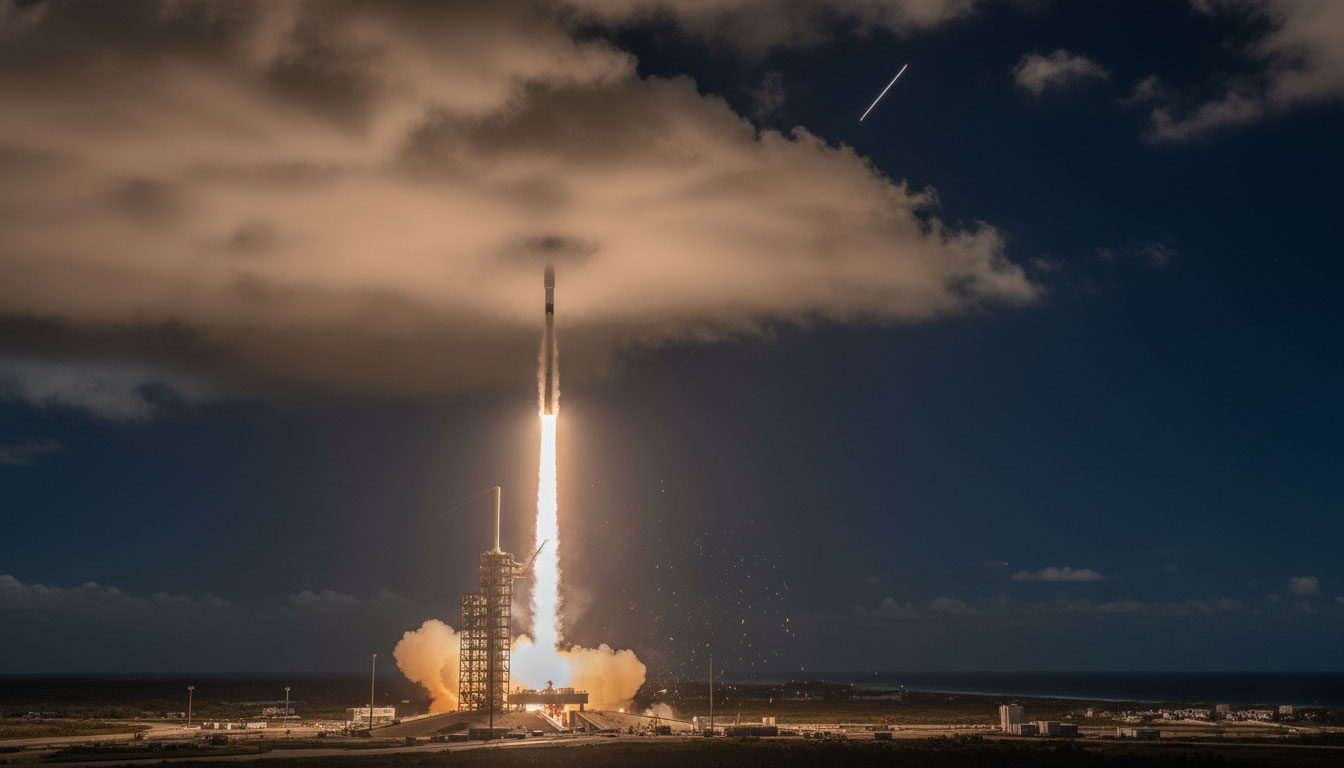
SpaceX Launches 29 in Overnight Florida Rocket Mission.In the quiet hours before dawn, SpaceX executed another precisely timed orbital mission from Florida’s Space Coast, sending a new batch of Starlink satellites into low Earth orbit. The overnight operation underscores the company’s steady acceleration in launch cadence and reinforces its central role in reshaping the global satellite communications market.
The mission, in which SpaceX Launches 29 Starlink satellites aboard a Falcon 9 rocket, reflects a pattern that has become increasingly familiar: rapid deployment, reusable hardware, and a focus on expanding broadband infrastructure beyond terrestrial limitations. While the launch itself was brief, its implications reach far beyond the Florida coastline.

As commercial spaceflight matures, such missions are no longer framed as experimental milestones. Instead, they are increasingly viewed as components of an industrial-scale logistics operation in orbit, one that blends aerospace engineering with digital infrastructure development.
Florida’s Role in Modern Spaceflight
Florida has reemerged as a central hub for global space operations, driven largely by private-sector activity. SpaceX’s use of launch facilities along the Atlantic coast has transformed the region into a near-continuous gateway to orbit.
When SpaceX Launches 29 satellites in a single mission, it highlights both logistical efficiency and regulatory coordination. Overnight launches, in particular, allow operators to manage airspace and maritime zones with minimal disruption, while also taking advantage of favorable orbital mechanics.
Why Overnight Launches Matter
- Reduced air and sea traffic interference
- Cooler atmospheric conditions that can benefit performance
- Optimized orbital insertion timing for satellite deployment
These factors collectively support SpaceX’s ability to maintain a rapid and reliable launch schedule, a capability few competitors currently match.
The Falcon 9: Reusability as Strategy
At the core of this mission was SpaceX’s workhorse Falcon 9 rocket, a vehicle designed from inception with reusability in mind. The booster used for the flight successfully completed its ascent and returned for a controlled landing, reinforcing the company’s cost-reduction model.
The repeated success of Falcon 9 missions has normalized what was once considered high-risk innovation. Each time SpaceX Launches 29 satellites using a flight-proven booster, it further validates reusability as a foundational principle rather than a technological novelty.
Key Falcon 9 Features
- Two-stage rocket architecture
- Autonomous drone ship landings
- Rapid refurbishment cycles
- High payload reliability
This approach has allowed SpaceX to undercut traditional launch costs while maintaining consistent performance metrics.
Starlink’s Expanding Constellation
Starlink, SpaceX’s satellite internet project, is designed to provide broadband coverage to underserved and remote regions worldwide. Unlike traditional geostationary satellites, Starlink operates in low Earth orbit, significantly reducing latency.
When SpaceX Launches 29 new satellites, the constellation becomes denser and more resilient. Each deployment improves network redundancy, bandwidth availability, and geographic coverage.
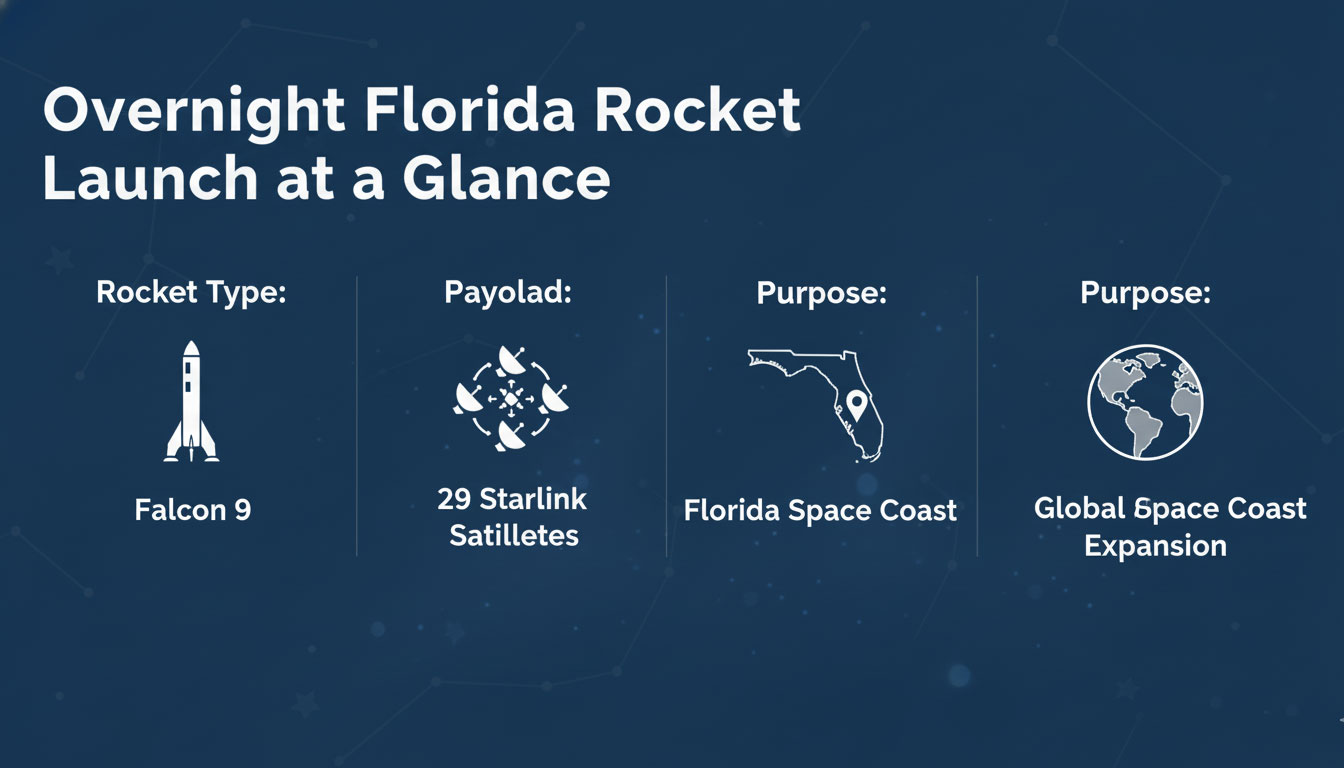
Key Information Table On: Mission Snapshot
| Category | Details |
|---|---|
| Launch Vehicle | Falcon 9 |
| Payload | 29 Starlink satellites |
| Launch Site | Florida Space Coast |
| Orbit Type | Low Earth Orbit (LEO) |
| Booster Recovery | Successful |
| Mission Purpose | Broadband network expansion |
This data illustrates the standardized yet highly effective nature of SpaceX’s current launch operations.
Strategic Importance of Satellite Internet
Satellite-based internet is increasingly viewed as critical infrastructure rather than a niche service. Governments, disaster-response agencies, and commercial enterprises now rely on space-based connectivity as a backup or primary solution.
As SpaceX Launches 29 additional satellites, it strengthens its position within a competitive and geopolitically sensitive market. Satellite networks are now intertwined with national resilience, emergency communications, and digital inclusion strategies.
Use Cases for Starlink Connectivity
- Rural and remote broadband access
- Maritime and aviation communications
- Disaster response and recovery
- Mobile and temporary installations
This versatility has made Starlink one of the most closely watched satellite projects globally.
Economic and Industrial Impact
Beyond connectivity, SpaceX’s launch activities have broader economic implications. Each mission supports a supply chain that includes aerospace manufacturing, software engineering, logistics, and regulatory compliance.
The frequency with which SpaceX Launches 29-scale missions signals an industrial rhythm that mirrors terrestrial manufacturing more than traditional space exploration. This shift has implications for workforce development, investment patterns, and national space policies.
Environmental and Regulatory Considerations
The rapid growth of satellite constellations has also prompted discussions around orbital congestion and space sustainability. Regulatory bodies and international organizations continue to assess best practices for debris mitigation and long-term orbital management.
SpaceX has publicly emphasized controlled deorbiting and collision-avoidance systems. Each time SpaceX Launches 29 satellites, these safeguards are tested at scale, contributing to broader industry standards.
Global Competition in Orbit
SpaceX is not alone in pursuing large-scale satellite networks. Companies and governments worldwide are developing their own constellations, each with distinct technical and regulatory approaches.
However, SpaceX’s ability to integrate launch services, satellite manufacturing, and network operations within a single organization gives it a structural advantage. The overnight Florida mission exemplifies this vertically integrated model in action.
What This Launch Signals for the Future?
The overnight mission represents more than another successful flight. It reflects a normalization of space access and a shift toward infrastructure-driven exploration.
As SpaceX Launches 29 satellites with increasing regularity, the boundary between space technology and everyday digital services continues to blur. Internet access, once constrained by geography, is steadily becoming an orbital utility.
The Florida overnight launch stands as a concise illustration of how far commercial spaceflight has evolved. Precision execution, reusable hardware, and a clear economic objective now define modern orbital missions.
By demonstrating that SpaceX Launches 29 satellites can be accomplished routinely and reliably, the company reinforces its role as a central architect of the emerging space-based internet economy. The implications will continue to unfold, not just above Earth’s atmosphere, but across the digital lives of users worldwide.


