
JYP Entertainment vs. HYBE: A Business Comparison of K-Pop Giants.The global K-pop industry has transformed into a multi-billion-dollar cultural force, with South Korea’s entertainment companies at the center of this growth. Among the leaders are JYP Entertainment, renowned for its disciplined training programs and long-standing hit artists, and HYBE Corporation, formerly Big Hit Entertainment, whose meteoric rise has redefined music marketing in the 21st century. Understanding their business models, revenue streams, and global reach offers insight into the competitive dynamics shaping contemporary K-pop.
JYP Entertainment was founded in 1997 by Park Jin-young, a singer-turned-producer, with a vision to combine rigorous artist training with global musical sensibilities. Over the years, JYP has nurtured iconic groups such as TWICE, GOT7, and Stray Kids, alongside solo acts like J.Y. Park himself. Its early focus on synchronized choreography, vocal precision, and international appeal positioned it as one of South Korea’s “Big Three” entertainment firms alongside SM and YG.
HYBE Corporation began as Big Hit Entertainment in 2005, led by CEO Bang Si-hyuk. Initially a smaller player in the industry, Big Hit’s strategic pivot with BTS in 2013 propelled the company to unprecedented global recognition. HYBE’s model emphasizes direct fan engagement, digital content distribution, and diversified revenue streams, including merchandise, concert production, and intellectual property.
Key Distinction: While JYP’s strength lies in consistent, methodical talent development, HYBE excels in leveraging digital platforms and global fandom engagement to maximize revenue and brand loyalty.
Revenue Streams and Financial Performance
JYP Entertainment’s business model is traditionally focused on three primary revenue channels:
- Music Production & Sales – Album sales, digital downloads, and streaming royalties constitute a large portion of revenue.
- Artist Management – Income from live performances, endorsements, and appearances.
- Content & Licensing – Television programs, reality shows, and merchandising rights.
In 2024, JYP Entertainment reported a revenue of approximately $300 million, with a net profit margin of around 15%, demonstrating steady growth from consistent domestic and Asian markets.
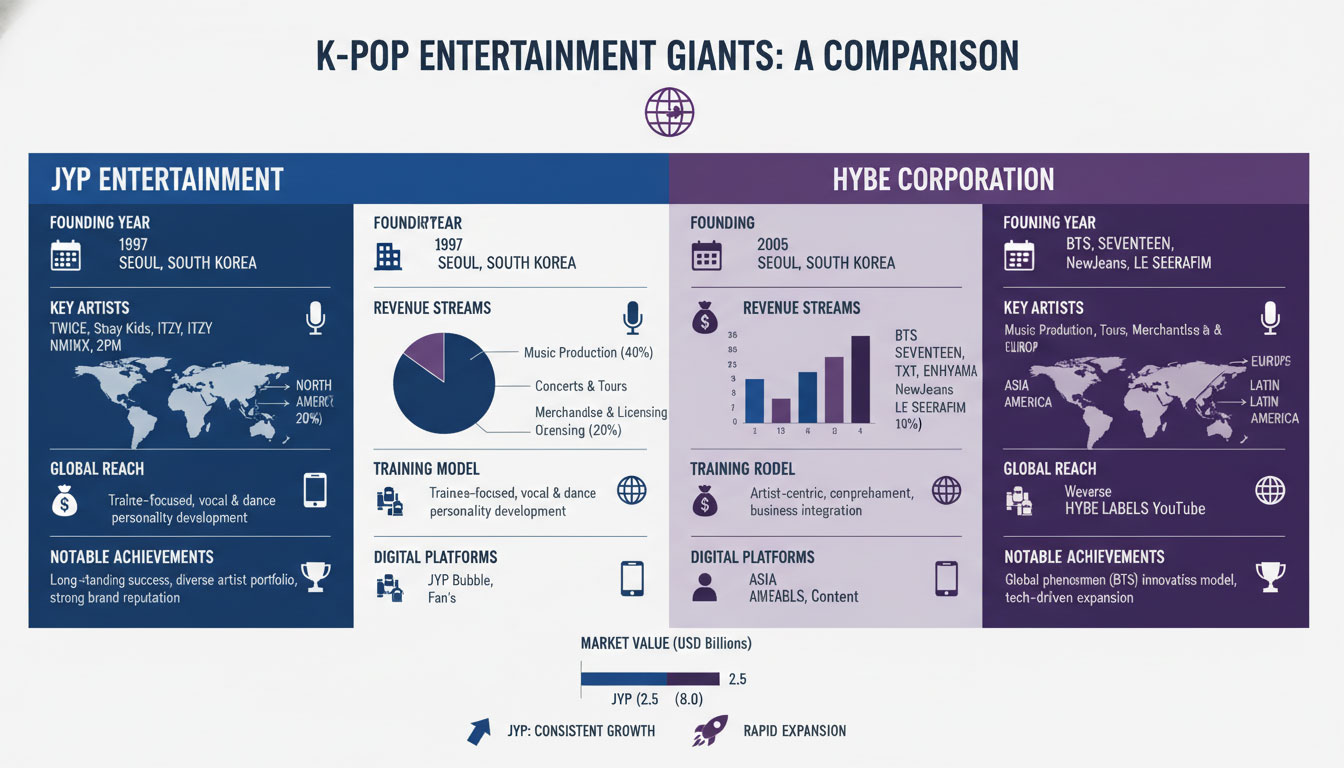
Key Table On JYP Entertainment vs. HYBE: A Business Comparison of K-Pop Giants
| Revenue Segment | HYBE 2024 Revenue Estimate | Notes |
|---|---|---|
| Music & Streaming | $500 million | Primarily from BTS and LE SSERAFIM releases |
| Merchandising & Licensing | $350 million | Includes Weverse Shop and global merchandise |
| Concerts & Events | $450 million | Live tours and virtual concerts worldwide |
| Investments & Subsidiaries | $200 million | Big Hit IP, Pledis, Source Music, ADOR |
| Total Revenue | $1.5 billion | Aggressive global expansion strategy |
The financial disparity reflects HYBE’s broader global strategy, while JYP maintains a more measured growth trajectory with a focus on domestic dominance and gradual international expansion.
Artist Development and Training Models
JYP Entertainment has earned its reputation for a rigorous, structured idol training system. Trainees undergo multi-year programs encompassing vocal, dance, foreign language, and media skills. This model emphasizes discipline and long-term preparation, ensuring that debuting artists are highly polished. Groups like TWICE and Stray Kids exemplify the results of this system: consistent performance quality and strong domestic fan bases.
HYBE’s approach is less uniform but highly innovative. While training remains intensive, there is a strong emphasis on self-expression and content creation. BTS’s members, for example, contribute to songwriting and production, creating a narrative of authenticity that strengthens fan engagement. HYBE also integrates technology platforms like Weverse to allow fans direct interaction with artists, driving loyalty and monetization simultaneously.
More: K-Pop Investment Guide: ROI Comparison of HYBE, SM, YG, and JYP
Global Influence and Market Penetration
JYP Entertainment has historically leveraged Asia-centric markets, including Japan, China, and Southeast Asia, establishing strategic partnerships with local labels and media companies. Recent initiatives include English-language releases and global tours for TWICE and ITZY, reflecting an ambition to expand beyond the regional stronghold.
HYBE, however, has aggressively targeted Western markets, exemplified by BTS’s Grammy performances and collaborations with artists like Coldplay and Ed Sheeran. The company has also acquired international labels and invested in Western entertainment technology, positioning itself as a global music conglomerate rather than merely a Korean pop label.
| Aspect | JYP Entertainment | HYBE Corporation |
|---|---|---|
| Headquarters | Seoul, South Korea | Seoul, South Korea |
| Founded | 1997 | 2005 |
| Key Artists | TWICE, Stray Kids, ITZY | BTS, LE SSERAFIM, TXT |
| Global Strategy | Gradual expansion | Aggressive global market penetration |
| Digital Fan Engagement | Moderate | High (Weverse, social media strategy) |
Branding and Intellectual Property Strategy
Branding in K-pop is not limited to artist image—it extends to content platforms, merchandise, and digital interaction. JYP Entertainment relies on a consistent visual and musical brand identity, emphasizing synchronized choreography and catchy, pop-driven music. Its content strategy includes variety shows and reality programming to maintain visibility and fan connection.
HYBE, by contrast, leverages a multi-layered IP strategy. Beyond music, HYBE has invested in gaming, virtual concerts, and global partnerships, including music distribution platforms and licensing deals. Their approach transforms artists into global brands, creating multiple touchpoints for revenue generation while maintaining cultural relevance across diverse audiences.

Challenges and Strategic Risks
Both companies face challenges in a rapidly evolving industry:
- JYP Entertainment:
- Maintaining relevance in global markets amid the dominance of HYBE.
- Balancing quality control with the speed of new debuts.
- Retaining talent as artists increasingly pursue solo or overseas opportunities.
- HYBE Corporation:
- Managing high operational costs and diversification risks.
- Ensuring sustained popularity post-BTS era.
- Navigating regulatory and cultural challenges in international markets.
The ability of both companies to innovate while preserving core values will determine their long-term positioning in the K-pop ecosystem.
Future Outlook
For JYP Entertainment, the strategy appears focused on sustainable growth and consistent quality. Plans for new groups, regional partnerships, and digital content expansion are likely to fortify its position as a leading K-pop label, even if it does not dominate globally.
HYBE’s trajectory suggests continued ambition to become a multinational entertainment conglomerate, leveraging technology and global fan engagement as primary growth drivers. Its diversified revenue model provides a buffer against market volatility and positions it to shape the future of the global music industry.
Ultimately, JYP Entertainment vs. HYBE represents not just a rivalry between two companies but a study in contrasting approaches to music, culture, and business: one rooted in discipline and consistency, the other in digital innovation and global fandom.


