
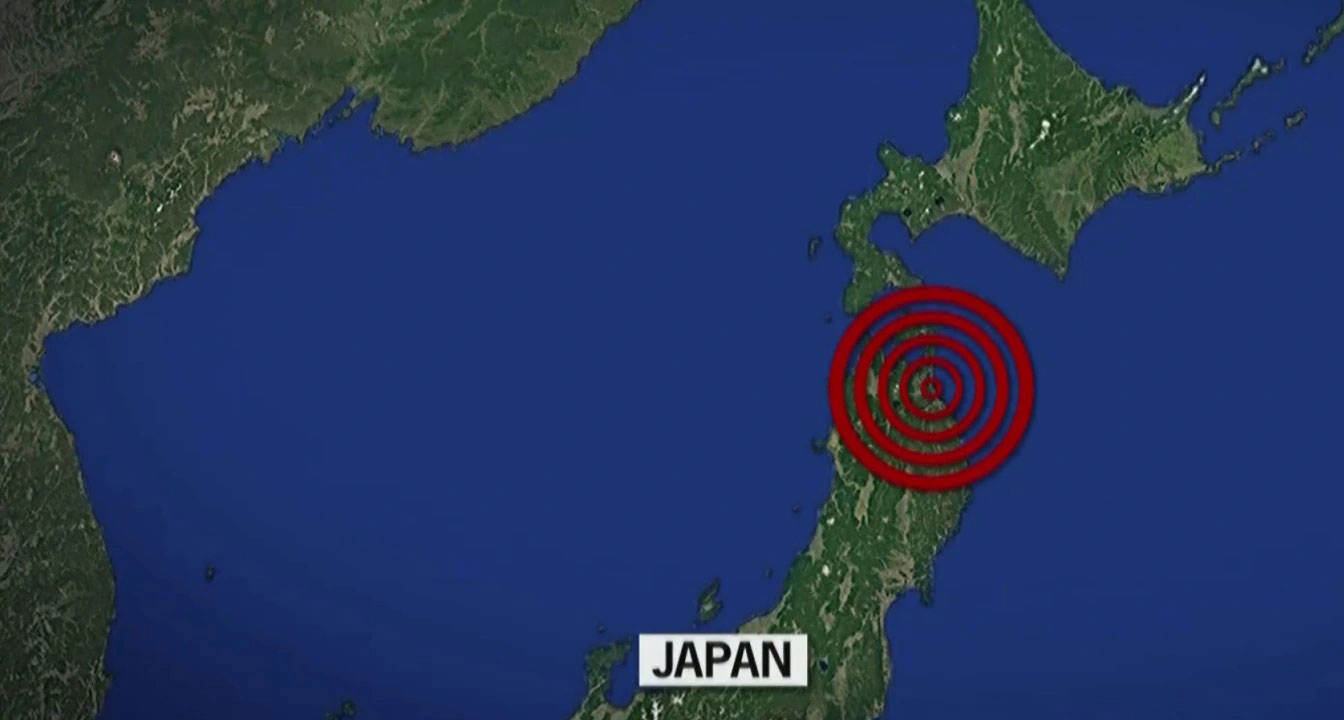
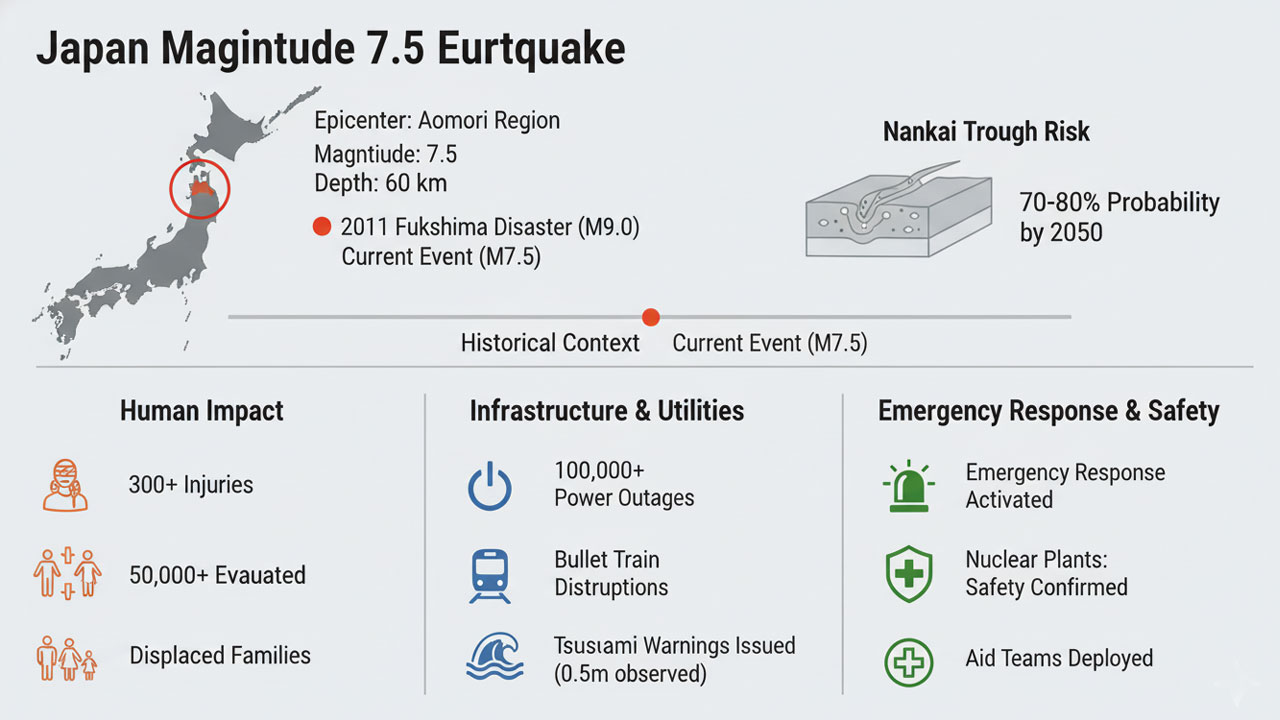
Japan Magnitude 7.5 Earthquake Strikes Northern Coast, Hundreds Affected. A magnitude 7.5 earthquake struck off the coast of northeastern Japan on Monday night, leaving dozens injured, prompting mass evacuations, and disrupting critical infrastructure. The Japan Meteorological Agency (JMA) reported the tremor occurred at 23:15 local time (14:15 GMT) at a depth of 50 kilometers (31 miles), approximately 80 kilometers off the coast of Aomori Prefecture.
In the immediate aftermath, tsunami warnings were issued along the northern Pacific coastline, though authorities later lifted them. Observed wave heights reached up to 70 centimeters (27 inches) in some locations.
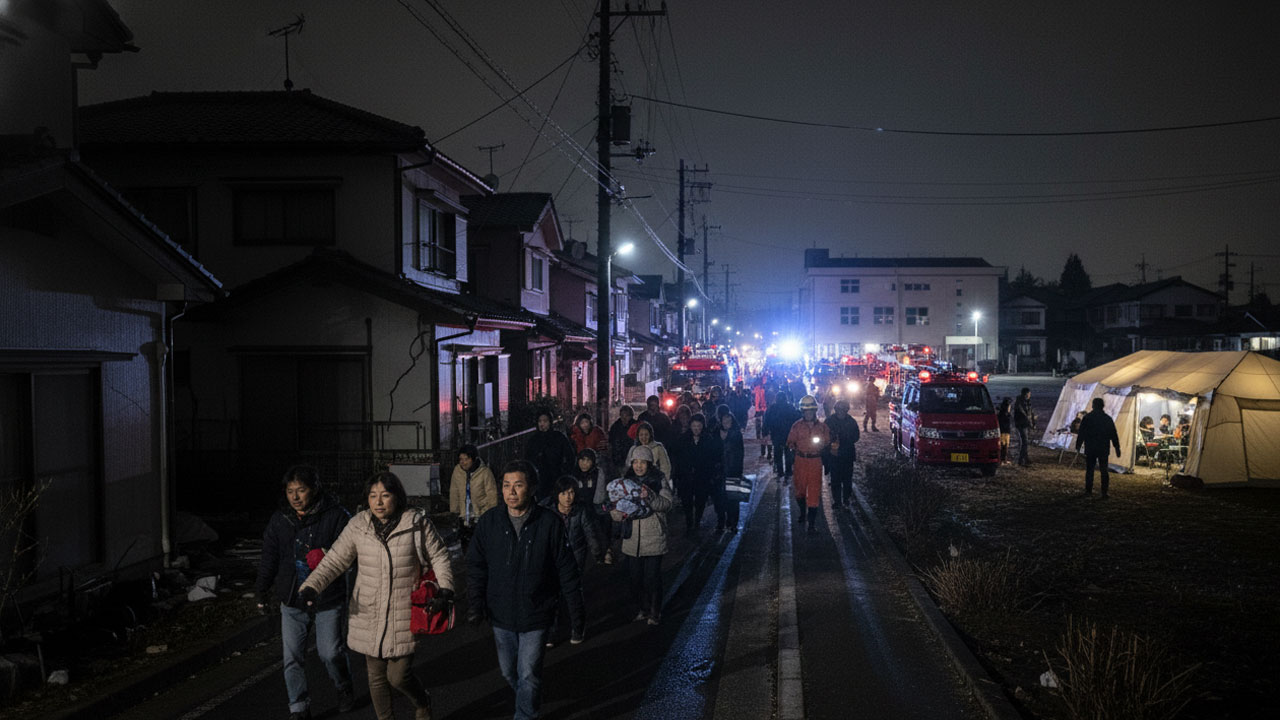
Thousands of residents were forced from their homes, and some train services along the northeastern coast were temporarily suspended. Power outages affected around 2,700 homes in the Aomori region, highlighting the quake’s widespread impact on daily life and essential services.
Human Impact and Evacuations
Injuries and Immediate Response
At least 30 people were reported injured following the tremor, though no fatalities have been confirmed. Japanese authorities ordered approximately 90,000 residents to evacuate, Reuters reported, as part of precautionary measures.
Prime Minister Sanae Takaichi addressed affected citizens, emphasizing the importance of preparedness:
“Reconfirm your daily earthquake preparedness, such as ensuring that you secure furniture, and prepare to evacuate immediately if you feel shaking.”
The government has mobilized emergency teams through the Prime Minister’s Crisis Management Center, coordinating rescue and relief operations across affected prefectures. Chief Cabinet Secretary Minoru Kihara confirmed that disaster response measures, including damage assessments and emergency support, are being implemented immediately.
Infrastructure and Services Disrupted
The earthquake caused significant disruptions to transportation and power infrastructure:
- East Japan Railway (JR East) suspended select train services along the northeastern corridor to ensure passenger safety.
- Tohoku Electric Power reported no irregularities at its Higashidori and Onagawa nuclear plants, maintaining stable operations despite the tremor.
- The Fukushima Daiichi nuclear site, disabled since the 2011 megaquake, showed no anomalies, as confirmed by both Japanese authorities and the International Atomic Energy Agency (IAEA).
While immediate damage appears contained, authorities warned that stronger aftershocks could occur in the following days. Residents have been advised to remain on high alert for at least one week, reflecting the ongoing seismic risk in the region.
Context: Japan’s Seismic Vulnerability
Geographic Factors
Japan is situated along the Ring of Fire, a geologically active zone prone to frequent earthquakes and volcanic activity. The country experiences approximately 1,500 earthquakes annually, ranging from minor tremors to catastrophic seismic events.
The latest quake in Aomori underscores Japan’s ongoing vulnerability to tectonic activity along the Pacific coast, including the historically active Nankai Trough, where previous megaquakes have caused devastating loss of life and property.
Historical Perspective
Japan has experienced several devastating earthquakes in recent history:
- March 11, 2011: A magnitude 9.0 earthquake struck off the eastern coast, triggering a tsunami that killed over 18,000 people and led to catastrophic damage at the Fukushima Daiichi nuclear plant. Entire towns were swept away, leaving long-term humanitarian and environmental consequences.
- Past seismic events along the Nankai Trough have also caused widespread casualties and structural damage, emphasizing the ongoing threat to the country’s infrastructure and population centers.
The Japan Earthquake Investigation Panel recently reported a 60–90% probability of a megaquake along the Nankai Trough within the next three decades, highlighting the urgent need for continued disaster preparedness and resilient infrastructure.
Government Measures and Preparedness
The Japanese government’s response protocol emphasizes rapid evacuation, infrastructure monitoring, and public communication. Following the Aomori quake:
- Evacuation orders were issued for tens of thousands of residents.
- Emergency coordination offices were activated to manage relief and logistics.
- Public guidance included securing furniture, preparing evacuation kits, and monitoring real-time updates from the JMA.
Prime Minister Takaichi reiterated the importance of community-level preparedness, noting that timely evacuation and adherence to safety protocols are critical in minimizing casualties and property damage.
Nuclear Safety Considerations
Japan’s nuclear facilities remain a central concern following any seismic activity. In this incident:
- Tohoku Electric Power reported stable operations at Higashidori and Onagawa plants.
- Fukushima Daiichi, decommissioned after the 2011 disaster, showed no anomalies.
- International monitoring agencies, including the IAEA, confirmed that no radioactive leaks occurred.
Despite reassurances, historical memory of the 2011 Fukushima disaster continues to influence public perception and emergency planning, emphasizing the high stakes of seismic events near nuclear facilities.
Economic and Transportation Impact
The earthquake’s disruption to transportation and energy systems underscores broader economic vulnerabilities:
- Train disruptions delayed commuters and cargo services along key regional corridors.
- Power outages in 2,700 homes, while localized, affected businesses, communication, and essential services.
- Emergency response measures incurred significant logistical costs for local and national agencies.
Analysts suggest that repeated seismic events, combined with Japan’s aging infrastructure, pose long-term economic risks that require both preventative investment and rapid disaster response strategies.
Broader Humanitarian Considerations: Japan Magnitude 7.5 Earthquake
Even moderate earthquakes can have cascading social effects:
- Evacuations place stress on temporary shelters and relief organizations.
- Injured populations require immediate medical attention, often straining regional healthcare facilities.
- Psychosocial impact: Residents, especially children, may experience trauma following sudden displacement or property damage.
Japan’s experience with frequent seismic activity has fostered a culture of disaster preparedness, including school drills, community training, and early-warning systems, which play a critical role in mitigating casualties.
Regional Seismic Risk – Nankai Trough
The Nankai Trough, a tectonic subduction zone off Japan’s Pacific coast, represents one of the most significant earthquake risks in the country:
- Historical records indicate multiple large-scale quakes in 1707, 1854, and 1944, each causing thousands of deaths.
- The trough’s activity could generate a tsunami exceeding 10 meters in worst-case scenarios.
- Ongoing monitoring and simulation exercises aim to improve early-warning capabilities and emergency responses.
The latest magnitude 7.5 earthquake near Aomori serves as a reminder of the high seismic volatility throughout Japan, particularly in regions along the Pacific coastline.
Key Data Table On Earthquake Overview
| Parameter | Details |
|---|---|
| Date & Time | December 8, 2025, 23:15 JST (14:15 GMT) |
| Magnitude | 7.5 |
| Depth | 50 km (31 mi) |
| Epicenter | 80 km off Aomori coast, northeastern Japan |
| Injuries | At least 30 reported |
| Fatalities | None reported |
| Evacuations | ~90,000 residents |
| Power Outages | ~2,700 homes |
| Train Disruptions | East Japan Railway services suspended |
| Nuclear Safety | No anomalies at Higashidori, Onagawa, or Fukushima |
| Tsunami | Warning issued, waves up to 70 cm (27 in), later lifted |
| Government Response | Crisis management center activated, emergency teams deployed |
Preparing for Aftershocks
Authorities emphasize that aftershocks are likely, potentially reaching significant magnitudes. Residents have been advised to:
- Remain vigilant and prepared for sudden shaking.
- Keep emergency kits ready, including food, water, and medical supplies.
- Secure heavy furniture and fragile objects to prevent injuries.
- Follow official updates via media, government apps, and local alerts.
Japan’s sophisticated earthquake warning systems have been credited with reducing casualties during previous seismic events, but public adherence to safety measures remains critical.
The Japan Magnitude 7.5 Earthquake underscores the country’s persistent vulnerability to seismic activity. While injuries were reported and tens of thousands of residents evacuated, robust disaster preparedness measures prevented a higher death toll.
The incident highlights the importance of:
- Maintaining resilient infrastructure.
- Continuous monitoring of nuclear facilities.
- Coordinated emergency response mechanisms.
- Community-level disaster awareness and preparedness.
As Japan continues to navigate its geologically volatile landscape, each earthquake serves as a reminder of the ongoing need for vigilance, early warning systems, and rapid humanitarian response.


