
Alexey Pajitnov Net Worth: How the Tetris Creator Built His Fortune? Alexey Pajitnov is a name synonymous with one of the most iconic video games of all time: Tetris. Developed in 1984 while he was working at the Soviet Academy of Sciences in Moscow, Tetris would go on to become a global phenomenon, influencing generations of gamers and shaping the puzzle game genre. Today, the financial legacy of Alexey Pajitnov is often a subject of curiosity among fans, gaming enthusiasts, and investors interested in the business side of game development.
The story of Pajitnov’s net worth is a study in intellectual property, licensing, and the eventual commercialization of software in post-Soviet and global markets. Unlike many game developers who saw immediate financial reward, Pajitnov’s early years with Tetris were marked by legal and political complexities that delayed substantial personal earnings.

Early Life and Career
Alexey Leonidovich Pajitnov was born on April 16, 1955, in Moscow, Russia. With a background in mathematics and computer science, Pajitnov worked at the Soviet Academy of Sciences, focusing on artificial intelligence and pattern recognition. His expertise in logic and spatial algorithms directly contributed to the development of Tetris, a game built on the concept of arranging geometric shapes efficiently—a natural extension of his academic focus.
Initially, Tetris was distributed within the Soviet Union with limited commercial opportunities. Pajitnov, as a state employee, had little control over the licensing of his game. It wasn’t until he emigrated to the United States and partnered with Nintendo and other international companies that he began to receive significant financial returns.
The Rise of Tetris and Its Global Impact
Tetris quickly transcended national boundaries, becoming one of the most recognizable video games worldwide. The game’s simple yet addictive mechanics made it a perfect fit for multiple platforms, from the original Electronika 60 computer to Nintendo Game Boy and eventually mobile devices.
The global popularity of Tetris created multiple revenue streams, including:
- Licensing Agreements: Companies paid to use Tetris on consoles, PCs, and mobile devices.
- Merchandising: Branded toys, apparel, and accessories expanded the franchise.
- Digital Sales: Mobile apps and online versions continue generating royalties.
Tetris has been downloaded billions of times, with ongoing adaptations and spin-offs, ensuring a steady stream of income for its rights holders.
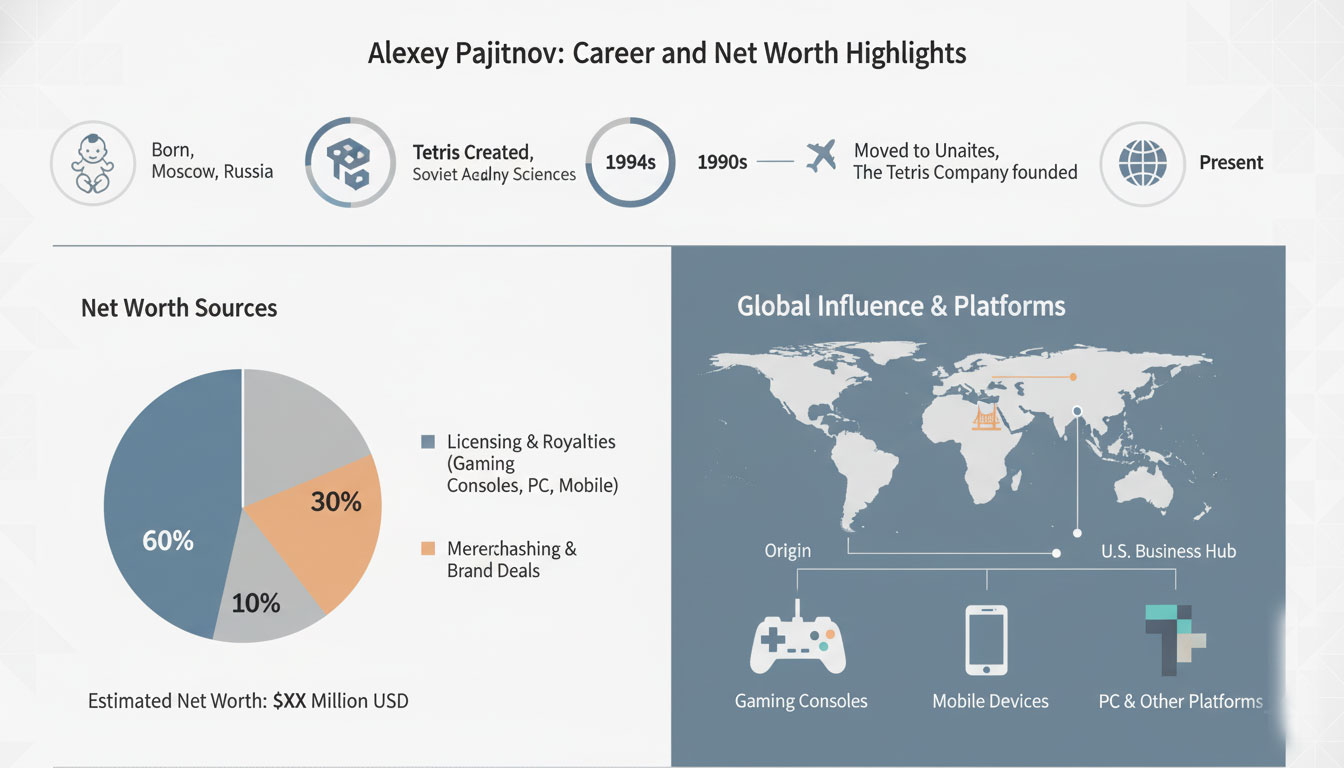
Alexey Pajitnov Net Worth: Breakdown
While exact figures vary depending on sources, most estimates place Alexey Pajitnov’s net worth in the $50–$60 million range as of 2025. Unlike other game developers who earned upfront payments, Pajitnov receives royalties through The Tetris Company, which he co-founded with Henk Rogers in the late 1990s.
Key factors influencing his net worth include:
- Royalty Income: Pajitnov earns a percentage from Tetris sales on all platforms.
- Corporate Partnerships: Licensing deals with Nintendo, Sony, and Microsoft have been lucrative.
- Investments: Pajitnov has diversified income sources, including software consulting and appearances at gaming events.
Key Information Table On: Alexey Pajitnov Net Worth
| Category | Details |
|---|---|
| Name | Alexey Pajitnov |
| Profession | Game Designer, Programmer |
| Known For | Creator of Tetris |
| Birthdate | April 16, 1955 |
| Nationality | Russian |
| Estimated Net Worth (2025) | $50–$60 million |
| Primary Income Sources | Tetris royalties, licensing, appearances |
| Company | The Tetris Company (Co-founder) |
| Industry | Video games, software development |
Challenges and Delayed Earnings
One of the unique aspects of Pajitnov’s career is that he did not initially profit from Tetris due to Soviet copyright laws. The Soviet state initially held the rights, and Pajitnov’s name was absent from early licensing deals. This situation persisted until the late 1980s and early 1990s when he relocated to the United States and negotiated rights to earn royalties.
This delayed compensation means that Pajitnov’s net worth, while significant today, represents decades of eventual earnings rather than immediate wealth after Tetris’ release.
Tetris Legacy and Cultural Influence
Alexey Pajitnov’s influence extends beyond finances. Tetris is credited with shaping the puzzle genre and influencing game design principles in multiple industries. The game’s minimalist graphics, addictive gameplay, and cognitive benefits (such as enhancing spatial reasoning and problem-solving skills) have cemented Pajitnov’s legacy in both gaming and cognitive science circles.
In addition, Tetris has been featured in educational programs, research studies, and competitive gaming tournaments, further reinforcing the cultural and intellectual impact of Pajitnov’s creation.
Ongoing Projects and Influence
Even after decades, Pajitnov remains active in the gaming community. He has worked with mobile developers to ensure new Tetris versions stay true to the original gameplay mechanics. He also participates in interviews, conventions, and panels discussing game design, software entrepreneurship, and the history of gaming.
His work illustrates how intellectual property, when managed carefully, can provide long-term financial stability and cultural relevance.

Factors That Could Affect Alexey Pajitnov Net Worth in the Future
- New Tetris Releases: Licensing deals with mobile platforms, VR adaptations, and online gaming platforms could increase royalties.
- Merchandising Expansion: Branded merchandise and collaborations with tech companies may add revenue streams.
- Intellectual Property Management: Legal disputes or licensing renewals could either positively or negatively affect income.
- Gaming Market Trends: Shifts in gaming consumption, including mobile vs console, will influence future royalties.
A Legacy Beyond Wealth
Alexey Pajitnov net worth reflects not only the financial success of Tetris but also the resilience and foresight of a developer navigating complex legal and international landscapes. From modest beginnings in Soviet Moscow to becoming an influential figure in global gaming, Pajitnov’s story exemplifies how creativity, innovation, and persistence can transform a simple idea into a lasting cultural and economic legacy.
His financial achievements, while impressive, are inseparable from the broader impact of Tetris on gaming, cognitive science, and global pop culture. For aspiring game developers and entrepreneurs, Pajitnov remains a model of combining intellectual rigor with entrepreneurial acumen.


