
The Evolution of Entertainment News in a Digital-First Global Media Era. For much of the 20th century, entertainment reporting occupied a distinct corner of the newsroom. It was glossy, periodic, and hierarchical. Editors decided what mattered, printers set the pace, and readers waited. Today, that ecosystem has been fundamentally rewritten. Entertainment News now moves at the speed of algorithms, trends, and short-form video, distributed instantly across borders and platforms.
This transformation did not occur overnight. It reflects broader shifts in media economics, audience behavior, and technological infrastructure. From print magazines stacked at newsstands to TikTok videos reaching millions in minutes, Entertainment News has evolved from curated storytelling into a continuous, participatory media stream.

Understanding this evolution is essential not only for journalists and editors, but also for policymakers, platforms, and audiences navigating an increasingly blurred line between reporting, promotion, and performance.
Entertainment Journalism Before the Internet
For decades, Entertainment News was defined by print publications such as Time, People, Variety, Rolling Stone, and The Hollywood Reporter. These outlets functioned as cultural gatekeepers. Their authority rested on access to studios, publicists, and artists, and on editorial processes that emphasized verification, narrative coherence, and long lead times.
Monthly and weekly cycles shaped how stories were told. A film premiere, album release, or celebrity profile unfolded slowly, framed by interviews and carefully edited prose. Errors were costly, corrections slow. In this environment, Entertainment News prioritized context over immediacy.
Audience Relationship and Trust
Readers consumed entertainment coverage as a supplement to broader news habits. Trust was implicit. The distance between subject, journalist, and audience reinforced credibility. While tabloids existed, mainstream entertainment journalism maintained clear editorial boundaries.
Visual Media Changes the Rhythm
The rise of cable television in the 1980s and 1990s accelerated the pace of Entertainment News. Channels such as E! Entertainment Television and MTV introduced continuous celebrity coverage, red-carpet broadcasts, and behind-the-scenes access.
Entertainment reporting became visual-first. Stories were no longer just read; they were watched. The emphasis shifted toward immediacy, personality, and spectacle, though editorial control largely remained centralized.
Commercial Pressures and Celebrity Branding
This era marked the growing alignment between Entertainment News and celebrity branding. Publicists, studios, and networks recognized the promotional value of coverage, leading to more managed access and strategic storytelling.
Digital Publishing and the Collapse of Gatekeeping
The early 2000s introduced a structural disruption. Online platforms eliminated printing costs and distribution barriers, allowing digital-native outlets such as TMZ, Perez Hilton, and later BuzzFeed to compete directly with legacy brands.
Entertainment News became faster, more fragmented, and increasingly driven by traffic metrics. Page views replaced subscriptions as the dominant currency. Headlines grew sharper, stories shorter, updates constant.
Search Engines and Audience Discovery
Search engines reshaped how entertainment journalism reached audiences. Google’s ranking systems rewarded relevance, freshness, and user intent. Entertainment News publishers adapted by optimizing headlines, metadata, and story structures for discoverability.
This period marked the beginning of SEO-driven editorial strategy, where journalistic judgment and algorithmic visibility became intertwined.
Facebook, Twitter, and the Rise of Real-Time Culture
By the 2010s, social media platforms had become primary distribution channels for Entertainment News. Breaking stories now spread through shares, retweets, and notifications rather than homepages.
Audiences no longer waited for outlets to publish; they encountered entertainment updates within their personal feeds, often stripped of original context. This shift redistributed power from publishers to platforms.
More: How to Choose the Perfect Entertainment Center for Any Living Room ?
The Audience as Participant
Comment sections, quote tweets, and reaction videos turned audiences into active participants. Entertainment News became conversational, reactive, and at times adversarial. Journalists were no longer distant observers but visible actors within public discourse.
A Platform Built for Virality
TikTok represents the most dramatic transformation yet. Its algorithm prioritizes engagement over follower count, allowing unknown creators to reach global audiences instantly. Entertainment News on TikTok is compressed, visual, and emotionally driven.
A single 30-second video can break a story, reinterpret a celebrity moment, or revive archival content. Context is optional; momentum is not.
Who Produces Entertainment News Now?
Traditional journalists now share the stage with influencers, fans, and creators. Entertainment News is produced by anyone with a smartphone and narrative instinct. Verification often follows virality, not the reverse.
This democratization has expanded voices but complicated standards. Accuracy competes with speed. Nuance competes with spectacle.
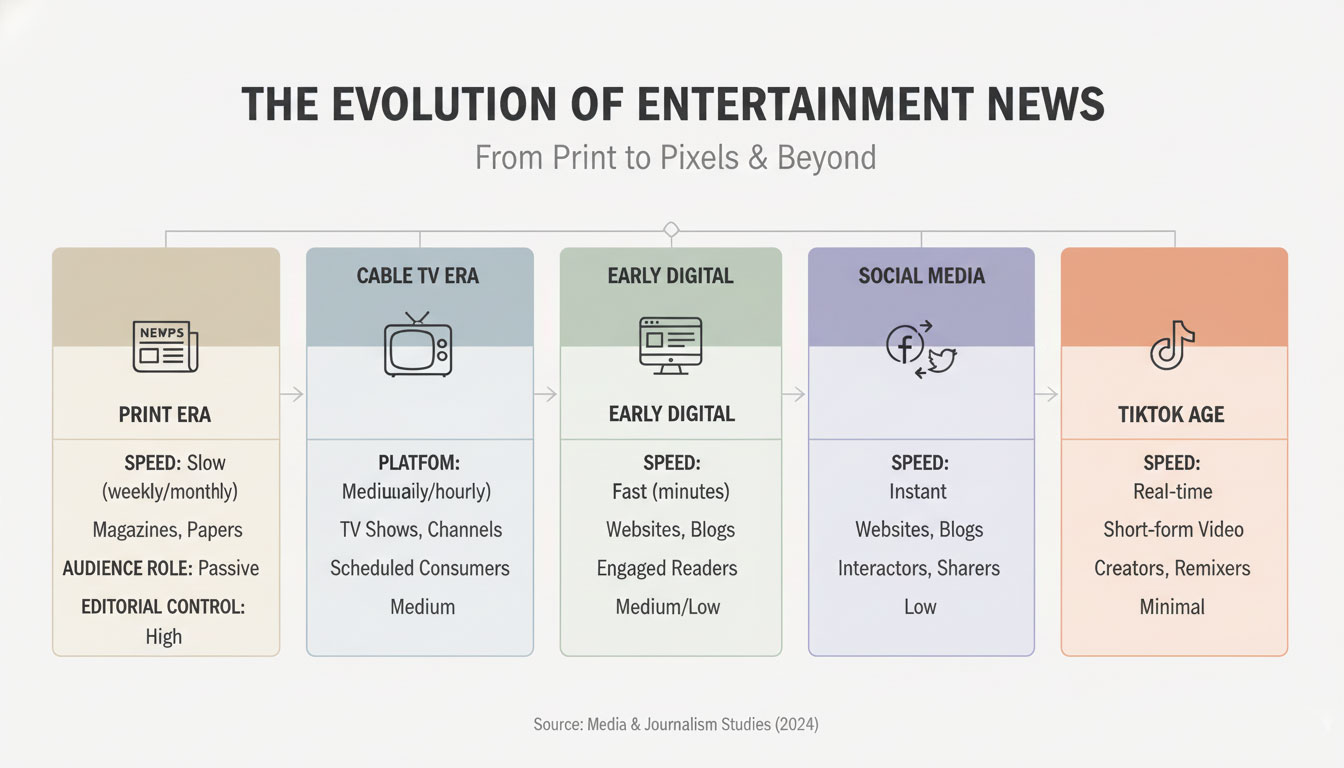
Key Information Table On Entertainment News Across Eras
| Era | Primary Platform | Editorial Control | Speed | Audience Role |
|---|---|---|---|---|
| Print Age | Magazines, Newspapers | Editors | Slow | Passive |
| Cable TV Era | Television Networks | Producers | Moderate | Viewers |
| Early Digital | Websites, Blogs | Editors + Metrics | Fast | Readers |
| Social Media Era | Facebook, Twitter | Algorithms | Real-time | Participants |
| TikTok Era | Short-form Video | Creators + Algorithms | Instant | Co-creators |
Monetization in the Platform Age
Revenue models for Entertainment News have fragmented. Advertising, branded content, affiliate links, and creator partnerships now coexist. Dependence on platform algorithms has introduced volatility, making sustainability a central challenge.
Ethics, Accuracy, and Responsibility
The speed of modern Entertainment News increases the risk of misinformation. Misquotes, miscontextualized clips, and unverified claims can spread globally within minutes.
Responsible outlets have responded by emphasizing transparency, corrections, and sourcing. However, ethical standards vary widely across platforms, particularly where creators operate outside traditional newsroom accountability.
From Hollywood-Centric to Multicultural
Entertainment News is no longer dominated by Hollywood alone. Korean pop culture, Indian cinema, African music, and Latin American streaming content now command global attention.
TikTok and streaming platforms have accelerated this globalization, enabling cross-cultural discovery and reshaping editorial priorities in international newsrooms.
Authority in an Algorithmic Ecosystem
Search engines increasingly evaluate Entertainment News based on Experience, Expertise, Authority, and Trust. Original reporting, transparent authorship, and contextual depth matter more than ever.
Google’s natural language processing systems favor comprehensive, well-structured content that demonstrates subject-matter understanding rather than click-driven repetition.
For publishers, this has reinforced the value of long-form analysis even within a short-form distribution environment.
Hybrid Journalism Models
The future of Entertainment News lies in hybrid models combining newsroom standards with platform-native storytelling. Successful outlets will adapt formats without abandoning verification.
Audience Trust as a Competitive Advantage
In an era of abundance, trust becomes differentiation. Audiences overwhelmed by content gravitate toward sources that consistently provide clarity, accuracy, and perspective.
Entertainment News will continue to evolve, but its core function remains unchanged: to interpret culture as it unfolds.
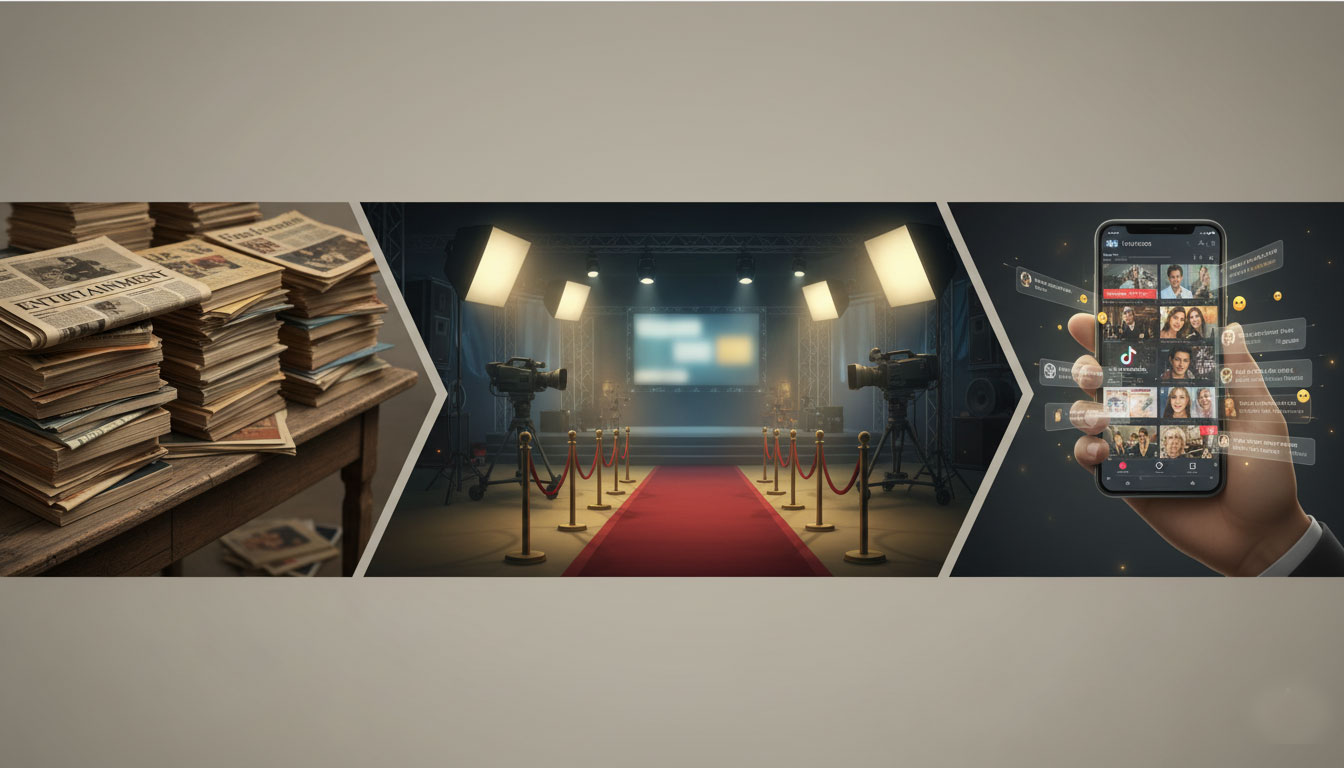
From print magazines to TikTok feeds, the evolution of Entertainment News mirrors broader changes in media, technology, and society. What was once slow and centralized is now immediate and decentralized. Authority has shifted, but responsibility remains.
As platforms evolve and audiences fragment, the enduring challenge for Entertainment News is balance: speed with accuracy, accessibility with depth, and innovation with trust.


