
How to Calculate Your Monthly Mortgage Payment? For prospective homeowners and seasoned property investors alike, the path to acquiring real estate is paved with complex financial considerations. Among the most critical, yet often misunderstood, aspects of this journey is determining the actual recurring cost of the investment. While online calculators provide instantaneous numbers, true financial literacy requires a deeper understanding of the mechanics behind the figures. Learning how to calculate your monthly mortgage payment (step-by-step) is not merely a mathematical exercise; it is a fundamental component of long-term fiscal responsibility and strategic wealth planning.
The advertised price of a home is rarely indicative of the monthly cash flow required to sustain its ownership. A mortgage payment is a composite figure, an amalgamation of debt service and obligatory property-related expenses that ensure both the lender’s security and the municipality’s revenue. To accurately forecast one’s housing budget, one must move beyond top-line numbers and dissect the anatomy of the loan commitment.
This analytical guide provides a comprehensive breakdown of the elements constituting a standard mortgage payment, offers the precise mathematical formula used by lenders globally, and explains the often-overlooked variables that can significantly alter monthly outlays. By mastering these calculations, borrowers gain the agency to navigate interest rate fluctuations, evaluate different loan products, and make informed decisions regarding down payments and affordability.

The Anatomy of a Mortgage Payment: Understanding PITI
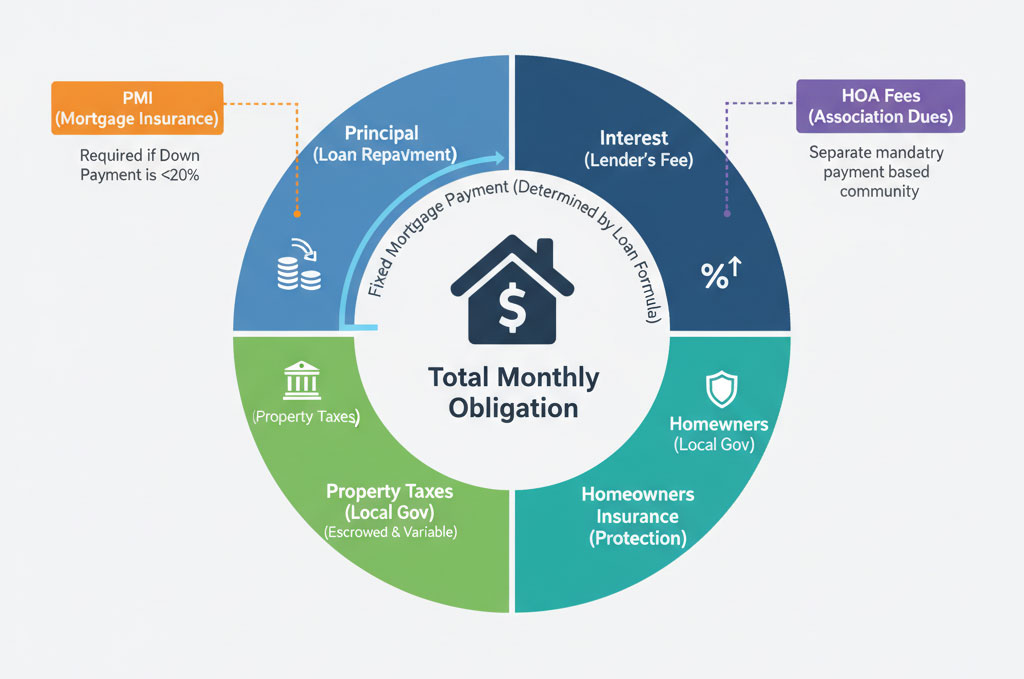
In the realm of residential lending, the total monthly obligation is frequently referred to by the acronym PITI, representing the four primary pillars of the payment structure: Principal, Interest, Taxes, and Insurance. Understanding how these components interact is the first requisite step before attempting any calculation.
Principal and Interest: The Core Debt Service
The majority of a standard mortgage payment goes toward servicing the debt itself.
- Principal: This is the portion of the payment dedicated to repaying the original amount borrowed. In the early stages of a long-term loan, the principal reduction is minimal, increasing gradually over time.
- Interest: This is the cost of borrowing money, paid to the lender. The interest is calculated monthly based on the remaining outstanding principal balance. Therefore, as the principal decreases, the absolute dollar amount paid in interest each month also declines, even if the interest rate remains fixed.
The relationship between principal and interest over the life of a loan is governed by an amortization schedule, a concept we will explore in greater detail.
Taxes and Insurance: The Escrow Components
Beyond the loan itself, lenders bear a vested interest in ensuring the property—the collateral for the loan—is protected and free of tax liens. Consequently, most residential mortgages typically include provisions for these costs, often held in an escrow account managed by the loan servicer.
- Property Taxes: These are levies assessed by local governments (county or municipality) based on the assessed value of the property. They fund local services such as schools, roads, and emergency services. Because tax rates and property assessments change, this portion of the monthly payment is an estimate that adjusts annually.
- Homeowners Insurance: This policy protects the property against damages from hazards such as fire, theft, or severe weather. Like taxes, insurance premiums can fluctuate year over year, impacting the total monthly payment.
The Mechanics of Amortization
Before proceeding to the manual calculation, it is vital to grasp the concept of amortization. A fixed-rate mortgage is an amortizing loan, meaning the total monthly payment for principal and interest remains constant throughout the loan term (e.g., 30 years). However, the allocation of that payment changes dramatically over time.
In the initial years of a mortgage, the vast majority of the payment is allocated to interest. This is because the interest percentage is applied to a large outstanding principal balance. As years pass and the principal balance is slowly chipped away, the interest portion decreases, and the principal portion increases proportionately.
Many borrowers who learn how to calculate your monthly mortgage payment (step-by-step) are surprised to realize that on a 30-year loan, they may not pay down half of their original principal balance until roughly year 18 or 19, depending on the interest rate. Understanding amortization is essential for evaluating the true cost of a loan and the benefits of making accelerated principal payments.
The Step-by-Step Calculation Guide (Fixed-Rate Mortgage)
While PITI includes taxes and insurance, the complex mathematical formula is used specifically to determine the Principal and Interest (P&I) portion of a fixed-rate mortgage. Taxes and insurance are typically added as simple monthly averages afterward.
Below is the standard actuarial formula used by financial institutions to calculate the monthly P&I payment.
The Variables
To execute the calculation, you need three precise figures:
- Loan Amount (P): The purchase price minus your down payment.
- Monthly Interest Rate (i): Your annual interest rate divided by 12 (months in a year). Note: You must use the decimal format (e.g., 6% = 0.06).
- Number of Payments (n): The total number of months in the loan term. (e.g., a 30-year fixed mortgage is 30 x 12 = 360 payments).
The Formula
The formula for the monthly principal and interest payment (M) is:
M = P [ i(1 + i)^n ] / [ (1 + i)^n – 1]
A Practical Example Calculation
Let us simulate a scenario to illustrate how to calculate your monthly mortgage payment (step-by-step) using realistic market figures.
Scenario Assumptions:
- Home Purchase Price: $400,000
- Down Payment: 20% ($80,000)
- Loan Amount (P): $320,000
- Annual Interest Rate: 6.5%
- Loan Term: 30 Years
Step 1: Convert the variables for the formula.
- P = 320,000
- i = (0.065 / 12) = 0.00541667 (It is crucial to carry out several decimal places for accuracy).
- n = 30 years * 12 months = 360
Step 2: Calculate the numerator [ i(1 + i)^n ].
- (1 + 0.00541667) = 1.00541667
- (1.00541667)^360 = 6.991797
- 0.00541667 6.991797 = *0.037872 (Numerator)
Step 3: Calculate the denominator [ (1 + i)^n – 1].
- (1.00541667)^360 – 1 = 6.991797 – 1 = 5.991797 (Denominator)
Step 4: Divide the numerator by the denominator.
- 0.037872 / 5.991797 = 0.0063206
Step 5: Multiply by the Principal (P).
- $320,000 0.0063206 = *$2,022.59
The monthly Principal and Interest payment is approximately $2,022.59.
Integrating Taxes, Insurance, and Additional Costs
The figure calculated above covers only the debt service. To arrive at the true total monthly outlay—the full PITI—we must add estimates for taxes and insurance, and potentially other required fees. These are not based on the complex loan formula but are rather annual costs divided by 12.
Calculating the Escrow Add-ons
Continuing with our $400,000 home scenario:
- Property Taxes Estimate: Assume the local tax rate is 1.2% of the home’s assessed value annually.
- $400,000 * 0.012 = $4,800 annual taxes.
- $4,800 / 12 months = $400 per month.
- Homeowners Insurance Estimate: Assume an annual premium of $1,200.
- $1,200 / 12 months = $100 per month.
The Total PITI Calculation: $2,022.59 (P&I) + $400 (Taxes) + $100 (Insurance) = $2,522.59 Total Monthly Payment.
The Impact of Loan-to-Value: Private Mortgage Insurance (PMI)
A critical variable that frequently complicates the process for those learning how to calculate your monthly mortgage payment (step-by-step) is Private Mortgage Insurance (PMI).
If a borrower’s down payment is less than 20% of the home’s purchase price (meaning the Loan-to-Value ratio is higher than 80%), lenders typically require PMI. This insurance protects the lender in the event of default; it does not protect the borrower. PMI can add significantly to the monthly cost—often between 0.3% and 1.5% of the original loan amount annually—until the borrower achieves 20% equity.
Homeowners Association (HOA) Fees
While usually paid directly to the association rather than through the mortgage lender’s escrow account, HOA fees are a mandatory monthly housing cost that must be factored into affordability calculations. Lenders include these fees when calculating a borrower’s debt-to-income (DTI) ratio to determine loan eligibility.
The following table summarizes how different loan structures and variables directly impact the composition of the monthly payment.
How to Calculate Your Monthly Mortgage Payment?
| Payment Component | Nature of Cost | Factors Influencing Change | Impact of 20%+ Down Payment | Impact of <20% Down Payment |
|---|---|---|---|---|
| Principal & Interest (P&I) | Fixed (on fixed-rate loans) | Interest Rate, Loan Term, Loan Amount | Lower loan amount reduces P&I. | Higher loan amount increases P&I. |
| Property Taxes (T) | Variable (Escrowed) | Local government tax rates, Property assessment value | No direct impact on tax rate. | No direct impact on tax rate. |
| Homeowners Insurance (I) | Variable (Escrowed) | Property location, coverage limits, claim history | No direct impact on premium. | No direct impact on premium. |
| Private Mortgage Insurance (PMI) | Variable/Temporary | Loan-to-Value (LTV) ratio, Credit score | Typically Not Required. | Required. Adds 0.3%-1.5% of loan balance annually to monthly costs. |
The Strategic Value of Financial Foresight
The ability to manually verify mortgage scenarios empowers consumers in a market often defined by opacity. By understanding the mathematical underpinnings of the mortgage payment, prospective buyers can move beyond reliance on loan officers for basic affordability questions.
This knowledge allows for more sophisticated financial modeling. For instance, a borrower can precisely calculate how an eighth of a percentage point difference in interest rate impacts the lifetime cost of the loan, or how increasing a down payment by $10,000 affects the monthly cash flow versus retaining that capital for investments elsewhere.
Furthermore, recognizing that taxes and insurance are variable components that will almost certainly rise over time is crucial for long-term budgeting. A payment that feels comfortable today may become burdensome in five years if property values—and subsequently property taxes—surge in the local market.
Ultimately, the process of learning how to calculate your monthly mortgage payment (step-by-step) is an exercise in due diligence. It transforms a significant financial obligation from an abstract number into a manageable, understandable set of components, providing the clarity necessary for secure and sustainable homeownership.
Newsizar.com brings you the latest and most significant stories from around the world, covering entertainment, technology, sports and feature — from AI innovations to major global events. Stay informed about the trends shaping today’s world. For news tips, editorial feedback or professional inquiries, reach out to us at newsdesk@newsizar.com
Follow Newsizar on Linkedin, Twitter, Facebook, Telegram and Subscribe to our YouTube Channel to get breaking news and updates first.


