
How Elon Musk’s Grok AI chatbot is reshaping classrooms in El Salvador? When governments experiment with artificial intelligence, the initiatives are often limited to pilot programs or small-scale trials. El Salvador’s decision to deploy an advanced AI system across more than 5,000 public schools marks a departure from that cautious norm. At the center of this effort is Elon Musk’s Grok AI chatbot, a conversational system developed under the xAI initiative, now being positioned as a digital learning assistant for students and educators nationwide.
The move places El Salvador among the most ambitious adopters of artificial intelligence in public education. While many countries continue to debate the classroom role of generative AI, El Salvador has chosen implementation over hesitation, betting that early adoption can help modernize a system long challenged by resource constraints and uneven access to instructional support.

Why El Salvador Is Turning to Artificial Intelligence
El Salvador’s education system faces structural pressures common across much of the developing world: overcrowded classrooms, teacher shortages, and limited access to up-to-date learning materials. Technology has long been viewed as a potential equalizer, but past initiatives relying on hardware alone have delivered mixed results.
The introduction of Elon Musk’s Grok AI chatbot reflects a shift from hardware-focused reforms toward software-driven instructional support. Rather than replacing teachers, the system is designed to act as an on-demand tutor, capable of answering questions, explaining concepts, and adapting responses to different learning levels.
What Grok AI Is Designed to Do
Grok is a large language model designed to process natural language queries and generate contextual responses. Unlike earlier educational software based on fixed content, Grok can engage in dynamic dialogue, adjust explanations, and reference a broad base of general knowledge.
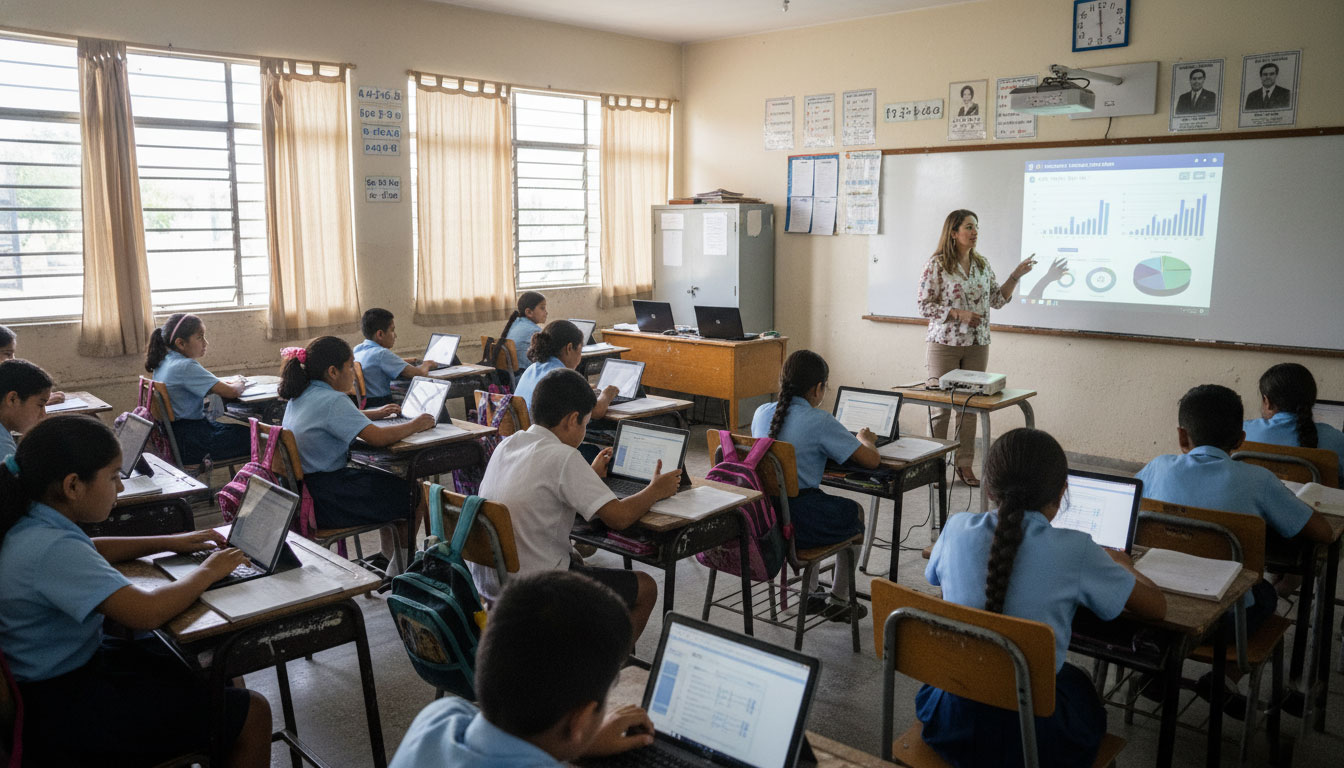
In classroom settings, Elon Musk’s Grok AI chatbot is expected to assist with subjects such as mathematics, science, history, and language learning. Students can ask follow-up questions, request simplified explanations, or explore topics beyond the core curriculum. For teachers, the system can help generate lesson outlines, quizzes, and supplementary materials.
Key Information Table On: of the Deployment
| Component | Description | Intended Impact |
|---|---|---|
| Scope | 5,000+ public schools | Nationwide access to AI support |
| User Base | Students and teachers | Personalized learning assistance |
| Core Function | Conversational AI tutoring | Reinforces classroom instruction |
| Integration Model | Supplementary tool | Supports, not replaces, educators |
| Policy Goal | Education modernization | Reduce learning gaps |
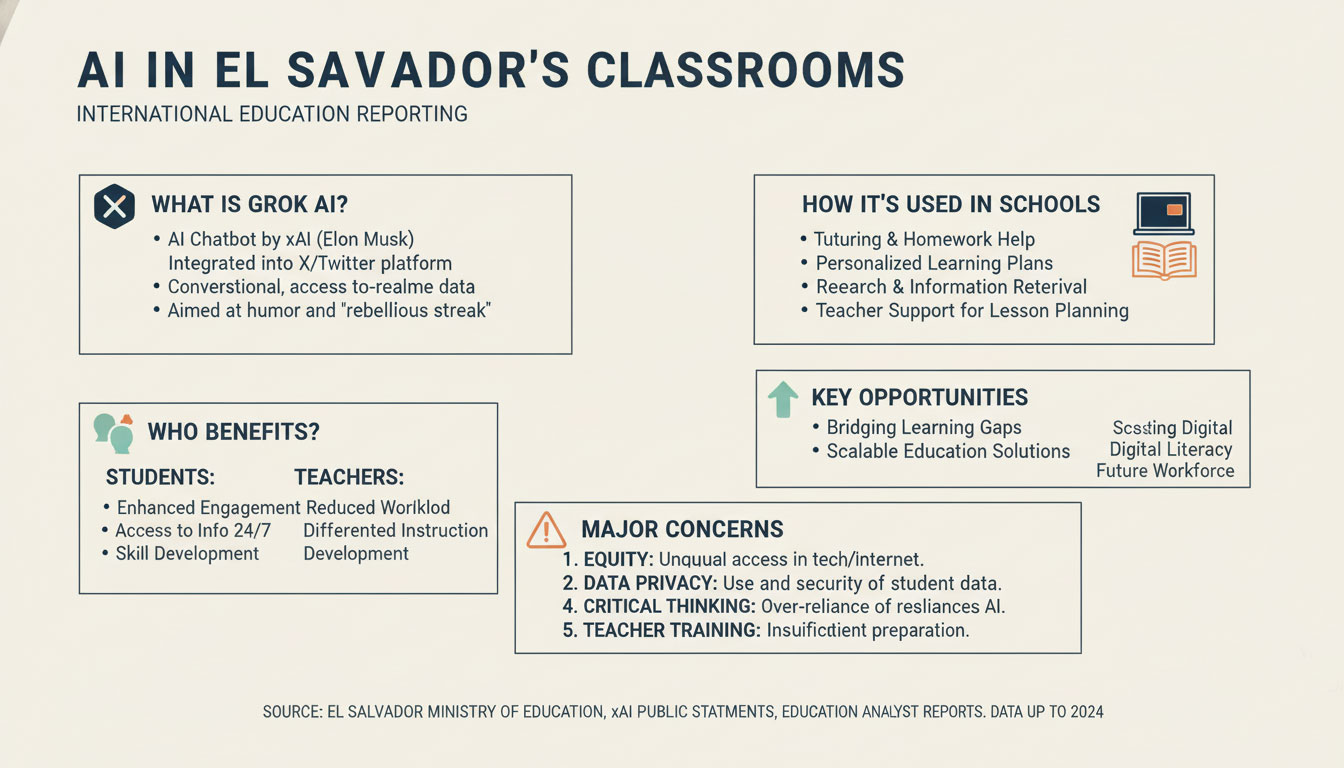
This framework illustrates how Elon Musk’s Grok AI chatbot is being positioned as infrastructure rather than an optional add-on.
Pedagogical Implications
The presence of AI in classrooms inevitably reshapes how learning occurs. Supporters argue that conversational AI can encourage curiosity, reduce fear of asking questions, and provide immediate feedback, particularly for students who struggle to keep pace in traditional settings.
Critics, however, caution that overreliance on Elon Musk’s Grok AI chatbot could weaken critical thinking if students treat AI responses as authoritative rather than interpretive. The effectiveness of the system, education experts emphasize, will depend heavily on how teachers frame its use within lesson plans.
Teachers at the Center, Not the Margins
Government officials in El Salvador have emphasized that AI is intended to augment, not displace, educators. Teachers remain responsible for instruction, assessment, and classroom management. The chatbot functions as an auxiliary resource, available when human attention is stretched thin.
This distinction is critical. Research on educational technology consistently shows that tools are most effective when guided by trained educators. The deployment of Elon Musk’s Grok AI chatbot therefore places new demands on teacher training, digital literacy, and curriculum alignment.
Equity and Access Considerations
One of the central arguments for nationwide AI deployment is equity. In theory, every student with access to a connected device gains a personalized tutor, regardless of geographic or economic background. In practice, disparities in connectivity, device quality, and digital skills may still shape outcomes.
El Salvador’s challenge will be ensuring that Elon Musk’s Grok AI chatbot does not inadvertently widen gaps between well-resourced urban schools and rural or underserved communities. Infrastructure investment and monitoring will be as important as the technology itself.
Data Privacy and Governance
The use of AI systems in education raises questions about data collection, student privacy, and oversight. Conversational AI relies on user input to function effectively, which means interactions may be logged, analyzed, or stored.
Authorities have stated that safeguards are being implemented to protect student data, but long-term governance remains a concern. As Elon Musk’s Grok AI chatbot becomes embedded in daily learning, transparency around data usage will be essential to maintaining public trust.
Global Context: Education and AI Policy
El Salvador’s move comes amid global debate over AI in schools. Some governments have restricted generative AI tools, citing risks of plagiarism and misinformation. Others have encouraged controlled experimentation, viewing AI literacy as a necessary skill for future economies.
By adopting Elon Musk’s Grok AI chatbot at scale, El Salvador positions itself at the forefront of this policy spectrum. The decision is likely to attract international attention from educators, technologists, and policymakers assessing whether bold adoption delivers measurable gains.
Measuring Success Beyond Novelty
The long-term value of the initiative will depend on outcomes rather than ambition. Metrics such as student engagement, comprehension, retention, and exam performance will shape assessments of success. Equally important will be qualitative feedback from teachers and students navigating daily classroom realities.
If Elon Musk’s Grok AI chatbot proves effective, it could influence education reform strategies across Latin America and beyond. If not, it may serve as a cautionary tale about deploying advanced technology without sufficient institutional support.
Ethical and Cultural Dimensions
Education is not merely a technical process; it is also cultural and social. Introducing an AI system developed outside the local context raises questions about language nuance, cultural references, and pedagogical norms.
Ensuring that Elon Musk’s Grok AI chatbot aligns with national curricula and cultural expectations will be critical. Localization, oversight, and continuous refinement are likely to determine whether students experience the system as empowering or alienating.
A Signal of Strategic Ambition
Beyond education, the initiative signals El Salvador’s broader ambition to position itself as a technology-forward nation. From digital governance initiatives to cryptocurrency experiments, the country has shown a willingness to test unconventional approaches.
The integration of Elon Musk’s Grok AI chatbot into public schools fits within this pattern. It reflects a belief that early adoption can create long-term advantages, even if short-term risks are unavoidable.
Conclusion
El Salvador’s nationwide deployment of AI-powered educational tools represents a significant moment in the global conversation about technology and learning. By integrating Elon Musk’s Grok AI chatbot into thousands of classrooms, the country is testing whether artificial intelligence can meaningfully support teachers, personalize learning, and reduce systemic constraints.
The outcome remains uncertain. What is clear is that the experiment will be closely watched. As governments worldwide grapple with how to integrate AI responsibly, El Salvador’s classrooms may offer some of the earliest answers.


