
Royal Navy Shadows Russian Submarines Through the English Channel.The English Channel is one of the world’s most consequential seaways, linking the North Sea with the Atlantic Ocean and serving as a crucial artery for global trade and military movement. In December 2025, the British Royal Navy conducted an extended maritime operation to shadow russian submarines as they transited this narrow passage, reflecting escalating Western concern about Russian naval activity near NATO’s western flank.
The operation spanned three days and involved continuous monitoring of a Russian diesel‑electric submarine alongside allied assets, highlighting both the logistical challenges of maritime defense and broader geopolitical tensions. As officials in London and Brussels reiterate their focus on maritime security, this episode illustrates how critical undersea and surface waters have become in the contest for influence and deterrence in European waters.
Geographic and Strategic Significance of the English Channel
The English Channel, often overlooked as a commercial thoroughfare, carries disproportionate strategic weight in NATO’s defense posture. It sits at the crossroads of Atlantic maritime approaches and the narrow Strait of Dover, where civilian and military vessels operate in close proximity. Its geography also compresses the domain in which allied forces must detect, identify, and monitor foreign naval activity.
Russia’s northern fleet periodically dispatches vessels through the Channel when repositioning assets between the Baltic, North Seas, and Atlantic. That such movements require a coordinated response from Western navies is a reflection of both routine maritime practice and heightened strategic sensitivity amid broader tensions with Moscow.
The December 2025 Operation
Tracking the Submarine Krasnodar
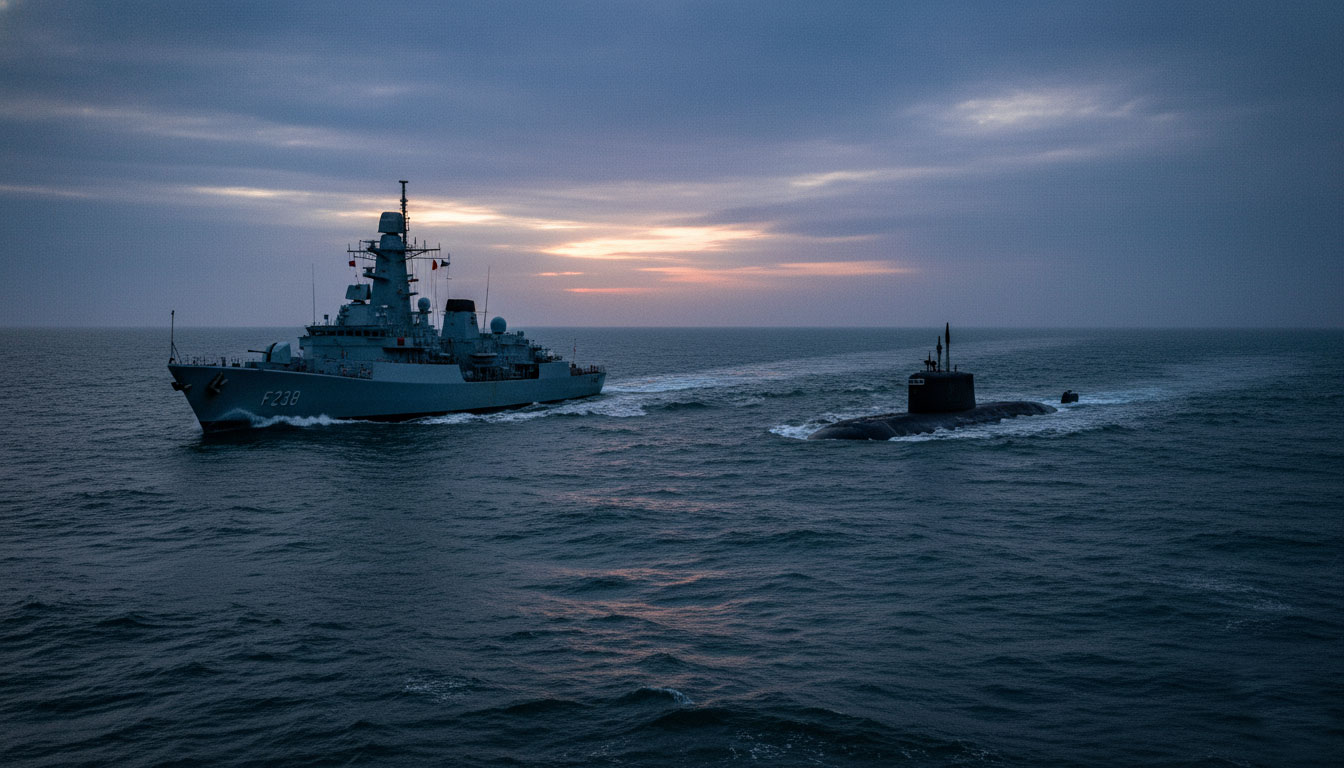
In early December, Royal Navy units, operating closely with NATO partners, tracked a Russian Kilo‑class submarine, the B‑265 Krasnodar, and its accompanying tug, Altay, as they steamed from the North Sea into the Channel. According to British naval sources, the submarine remained surfaced throughout the voyage, even in adverse weather, a condition that simplified observation but underscored its intention to transit in full view of allied forces rather than engage in stealth operations.
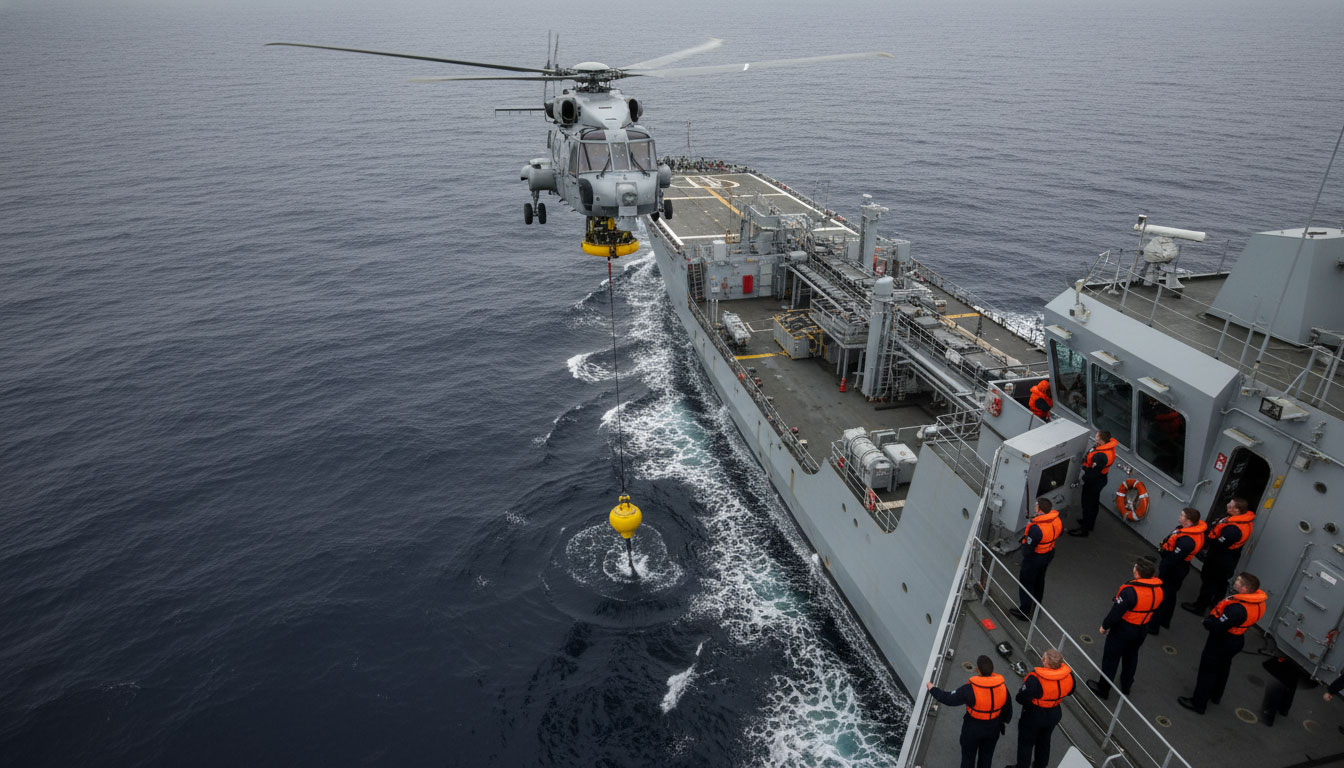
Instead of attempting to conceal itself beneath the surface, the Krasnodar’s visible passage allowed Western maritime patrols to shadow its movements closely, maintaining a constant picture of its position and heading. A Royal Fleet Auxiliary tanker equipped with a Merlin helicopter played a central role, providing air‑sea coordination and anti‑submarine surveillance capabilities.
Multi‑Domain Surveillance
The operation demonstrated the layered nature of modern maritime monitoring. Surface vessels, embarked helicopters, and onboard sensor suites formed a network capable of detecting and confirming the presence of a submarine throughout its navigation. Allied air assets, including maritime patrol aircraft, supplemented these efforts by providing overhead surveillance and rapid reaction capability, underscoring the integrated approach required for effective maritime domain awareness.
Handover to NATO Allies
As the Krasnodar approached the western approaches off Ushant, northwest France, responsibility for continuous monitoring shifted to a NATO ally. This handover mechanism is a standard practice in multinational operations and reflects a shared commitment among alliance members to ensure non‑hostile foreign warships and submarines are observed as they transit internationally recognized routes close to allied shores.
A Pattern of Increased Activity
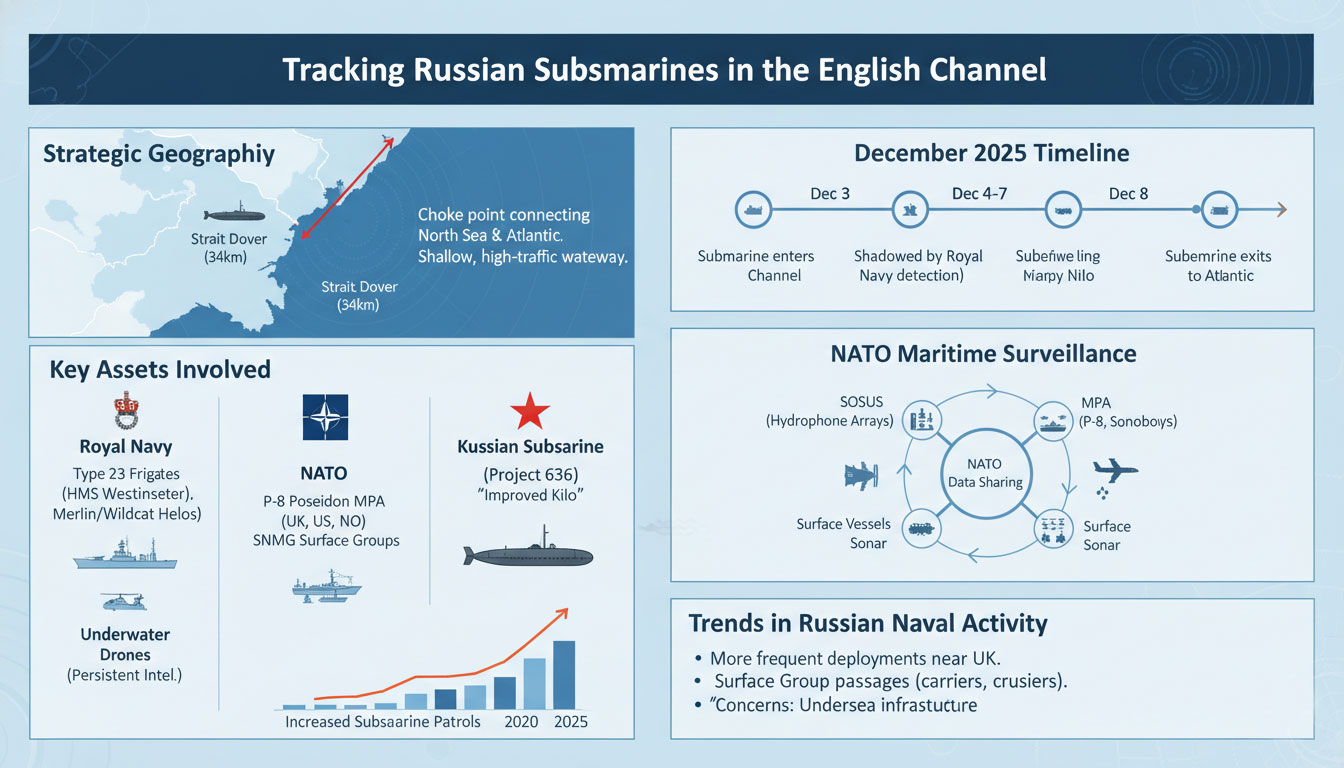
This recent shadowing follows a broader pattern of heightened Russian naval presence near Western waters. According to defence officials, activity by Russian naval vessels around UK maritime approaches has increased by roughly 30 percent in the past two years, prompting the Royal Navy and NATO to maintain a more vigilant and persistent posture.
In addition to submarine transits, Russian surface warships, intelligence‑gathering vessels, and other assets have been observed moving through these strategic chokepoints, often followed by allied ships and aircraft in coordinated monitoring operations.
Historical Context: NATO and Russian Naval Movements
The current operational tempo builds on longstanding patterns of naval interaction. Since the end of the Cold War, Baltic and Northern fleets have navigated through the Channel and North Sea to access broader oceanic theaters. In recent decades, NATO navies, including the Royal Navy, have routinely dispatched surface ships and submarines to monitor such passages, both to assert freedom of navigation and to deter potential aggressive maneuvers.
Historical instances, such as prior shadowing of Russian attack submarines and destroyers, underscore a continuity of maritime surveillance practices that are now intensified by contemporary geopolitical friction.
Key Information Table On: Naval Assets and Capabilities
| Asset Type | Role and Capability |
|---|---|
| Royal Fleet Auxiliary RFA Tidesurge | Provides logistical support and serves as a platform for embarked helicopters and sensors |
| Merlin Mk2 Helicopter | Anti‑submarine warfare sensor and response platform capable of dipping sonar and sonobuoy deployment |
| Maritime Patrol Aircraft | Long‑range aerial surveillance and detection |
| NATO Surface Units | Provide layered monitoring and maintain visual contact with target vessels |
| Russian Kilo‑class Submarine | Diesel‑electric submarine designed for anti‑ship and coastal defence |
This table reflects the complexity of modern naval operations, where logistics, sensors, and multi‑domain platforms contribute to sustained situational awareness over open waters.
Political and Security Implications
NATO’s Response
The Royal Navy’s tracking of russian submarines through the English Channel is not merely tactical; it carries diplomatic and strategic significance. Allied officials emphasize transparency and adherence to international law, noting that vessels have the right to innocent passage. Nonetheless, the presence of advanced Russian naval technology near allied maritime approaches serves as a reminder of ongoing geopolitical competition and the need for robust deterrence.
In parallel, the UK recently unveiled “Atlantic Bastion,” a broad initiative leveraging AI‑enabled undersea surveillance networks to enhance maritime domain awareness and counter submarine threats across the North Atlantic. This program reflects wider concern within defence circles about protecting critical infrastructure, including undersea communications cables and energy pipelines, from disruption or surveillanc.
Domestic and International Reactions
British defence officials caution that Russian naval movements signal not just routine transit, but a testing of allied readiness and resolve. Parliamentary debates and defence briefings have underscored the need for sustained investment in naval capabilities, from patrol vessels to advanced sensor networks, to ensure that NATO can maintain maritime superiority along key sea lines of communication.
Internationally, NATO allies have echoed these concerns, with coordinated patrols and intelligence sharing becoming central features of alliance maritime strategy in 2025.
Strategic Outlook: Undersea Threats and Maritime Security
The December operations reaffirm that the undersea domain remains a critical frontier in contemporary geopolitics. As Russia continues to modernize its submarine fleet and NATO enhances its anti‑submarine warfare capabilities, the interaction of surface and subsurface assets will shape maritime security for years to come.
While the immediate passage of the Krasnodar through the English Channel concluded without incident, the event highlights enduring challenges faced by alliance defence planners: balancing routine navigation rights with vigilant monitoring, and sustaining readiness in a complex, often contested maritime environment.
Putting tactical actions into a broader framework, defence analysts note that every transit of russian submarines near strategic chokepoints like the Channel invites scrutiny not just of capability, but of intent—a dynamic central to how Western navies prepare for future undersea and surface threats.


