
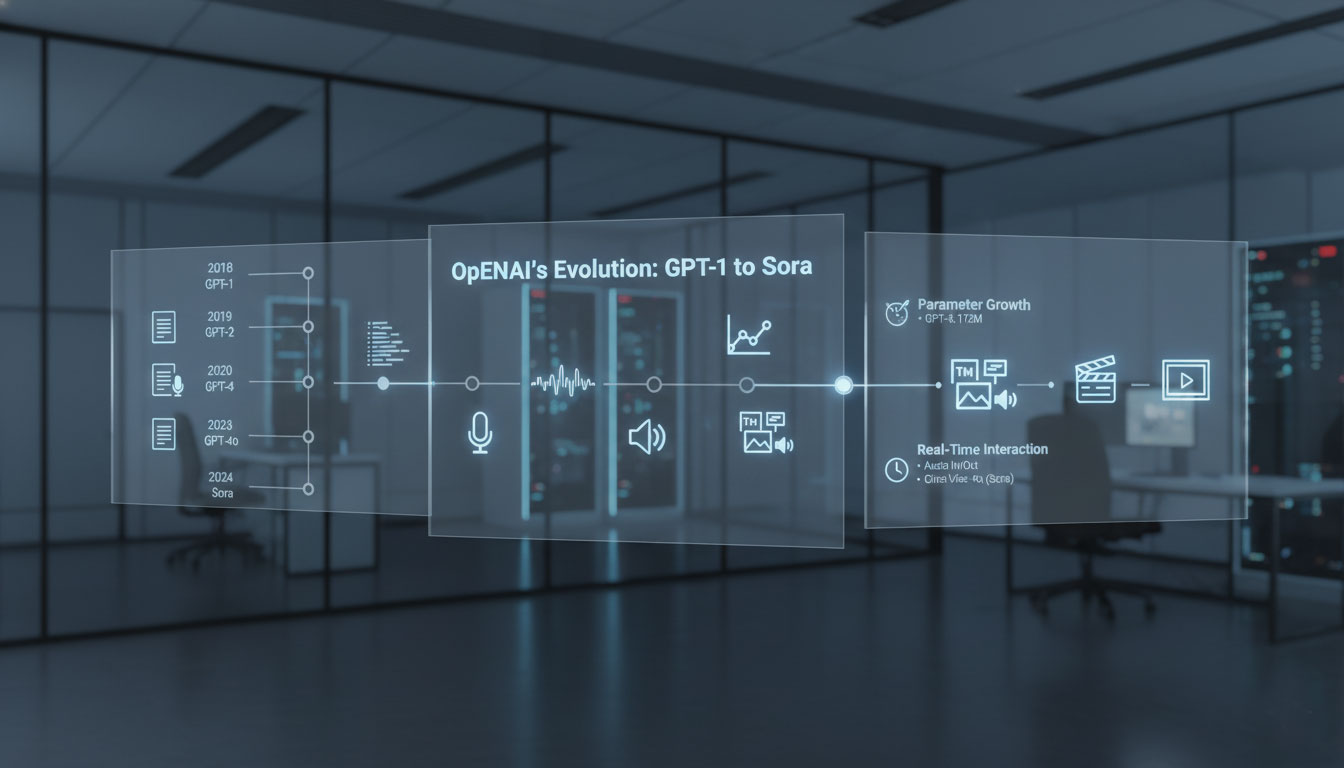
Major Milestones in OpenAI News: Tracing the Development from GPT-1 to Sora. Artificial intelligence has experienced rapid and far-reaching transformation over the last decade, with OpenAI positioned as one of the field’s most influential drivers of research, deployment, and public debate. Its sequence of innovations, from early language modeling to multimodal generation systems, has prompted global discussion about the economic, scientific, and regulatory implications of advanced AI. To understand that trajectory, it is essential to examine Major Milestones in OpenAI News: Tracing the Development from GPT-1 to Sora as part of a broader narrative about the rise of large-scale neural networks and the role of research institutions in shaping the future of intelligent systems.
This article presents a structured, in-depth chronicle of OpenAI’s model development, contextualizing each release within the larger technological landscape while assessing the institution’s shift in governance, research practices, and deployment strategy.
The Early Years of Language Modeling
GPT-1: Establishing a New Direction
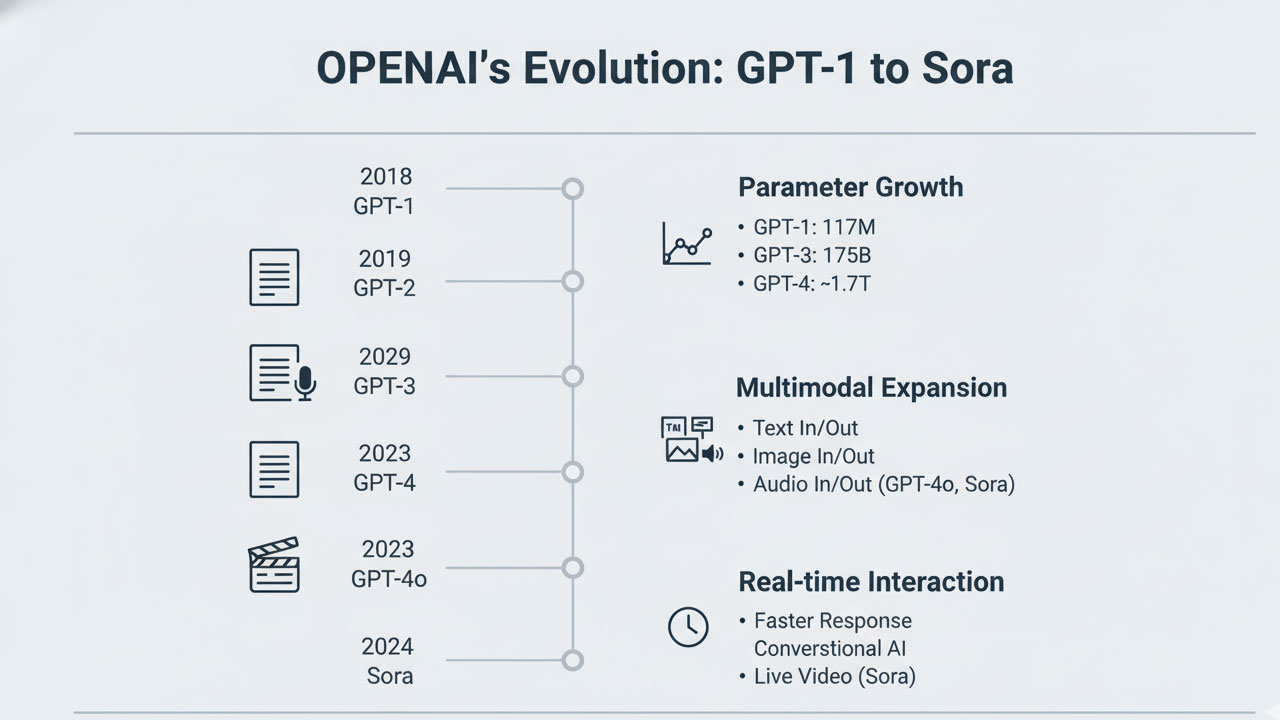
OpenAI introduced GPT-1 in 2018, marking its move toward large-scale transformer-based language models. The model contained 117 million parameters and demonstrated the potential of unsupervised pretraining on broad text corpora. While modest by today’s standards, GPT-1 represented a foundational proof that general-purpose models could learn linguistic structures at scale without supervised datasets.
At the time, transformer architecture had been introduced only months earlier, and OpenAI’s decision to build upon that framework was strategically significant. GPT-1 established the organization’s long-term commitment to exploring scaling laws and the behavior of increasingly large models.
GPT-2: A Turning Point for Public Debate
The Model That Sparked Widespread Attention
GPT-2, released in 2019, accelerated public discourse about advanced text generation. With 1.5 billion parameters, it produced more coherent text and longer contextual reasoning than previous models. What generated global attention, however, was OpenAI’s decision to delay the release of the full model, citing concerns about potential misuse.
This marked an inflection point: AI research institutions began grappling with dual commitments to openness and safety. GPT-2’s staged release established a template for future protocols, influencing debates around model access, governance, and responsible research dissemination.
GPT-3: The Breakthrough That Reshaped the Industry
A Model That Reached General Public Awareness
With 175 billion parameters, GPT-3’s 2020 release shifted AI from a research niche to a mainstream global conversation. Its emergent capabilities in text generation, code writing, translation, and reasoning caught industry observers by surprise. Developers rapidly integrated GPT-3 into applications ranging from content generation to conversational interfaces.
This period also saw OpenAI introduce its API model, a strategic move toward commercial deployment. Rather than releasing weights publicly, OpenAI offered controlled access to the model through a cloud interface. This represented a change in organizational philosophy, balancing innovation with controlled distribution.
Key Information Table On OpenAI Model Evolution
| Model | Release Year | Parameter Size | Notable Contributions | Global Impact |
|---|---|---|---|---|
| GPT-1 | 2018 | 117M | Introduced transformer-based language modeling | Foundation for large-scale LLM research |
| GPT-2 | 2019 | 1.5B | Generated public debate on responsible release | Raised awareness of safety and governance |
| GPT-3 | 2020 | 175B | Delivered breakthrough performance across tasks | Catalyzed global adoption of AI applications |
| ChatGPT | 2022 | Based on GPT-3.5 | First mass-market conversational AI | Sparked widespread AI adoption |
| GPT-4 | 2023 | High parameter estimates (undisclosed) | Improved multimodal reasoning | Used in education, enterprise, research |
| GPT-4o | 2024 | Optimized architecture | Native multimodal input/output | Enhanced real-time interaction |
| Sora | 2024 | Proprietary multimodal video model | High-fidelity video generation | Reframed debate on generative media |
The ChatGPT Moment: Global Cultural Adoption
From Research Tool to Household Name
In late 2022, OpenAI released ChatGPT, a conversational interface that transformed public perception of AI. Built initially on GPT-3.5, it offered users a natural language system capable of answering questions, creating content, and providing explanations. ChatGPT’s accessibility democratized interaction with AI, rapidly setting adoption records across education, media, programming, and business.
This moment triggered the largest wave of generative AI experimentation in history, prompting governments, corporations, and academic institutions to accelerate conversations about regulation, copyright, and social implications.
GPT-4: Advancing Multimodal Intelligence
More Reliable, More Capable: Major Milestones in OpenAI
GPT-4, introduced in 2023, offered a notable step forward in reasoning, factual accuracy, and safety alignment. Although parameter count details were not disclosed, the model exhibited superior performance across standardized tests, multimodal tasks, and professional benchmarks.
OpenAI positioned GPT-4 as a system capable of supporting enterprise and high-stakes applications, including education, legal analysis, technical writing, and research assistance. Its multimodal capabilities, allowing both text and image inputs, moved the conversation toward more integrated forms of intelligence.
GPT-4o: A Shift Toward Real-Time Multimodality
Breaking Down Input Barriers
Released in 2024, GPT-4o introduced a unified architecture enabling real-time multimodal processing across text, audio, and vision. The “omni” design allowed the model to perform interactive tasks more fluidly, mimicking human conversational dynamics and perception.
GPT-4o represented OpenAI’s ambition to build AI systems that could engage in seamless, human-level interaction across sensory modes. This shift also aligned with broader industry trends emphasizing ambient computing and intelligent assistants.
Sora: The Next Frontier in Video Generation
A Model That Redefined Generative Media
Sora, OpenAI’s text-to-video model unveiled in 2024, marked a significant expansion beyond conversational systems. Capable of generating high-fidelity, coherent videos from textual descriptions, Sora pushed generative AI into new domains of filmmaking, advertising, education, and simulation.
The system’s ability to model physics, spatial dynamics, and temporal consistency represented an important milestone in generative research. Its release intensified discussion about synthetic media, authenticity, and intellectual property regulation.
The Broader Implications of OpenAI’s Model Evolution
Research Transformation
OpenAI’s releases have become benchmark events for AI research. Each model introduced methodological insights into scaling laws, training efficiency, safety alignment, and multimodal integration. The innovation cycle accelerated global competition among research institutions and technology companies.
Policy and Governance
OpenAI’s trajectory has influenced regulatory dialogues worldwide. Debates on AI safety, transparency, access, and intellectual property emerged in parallel with each major release. Policymakers now closely monitor the organization’s work as part of broader regulatory frameworks.
Economic Impact
From enterprise automation to consumer applications, OpenAI’s models underpin a growing sector of AI-driven products and services. The organization’s focus on safe deployment has shaped how businesses integrate generative technologies into operations, customer service, and analysis.
Why These Milestones Matter Now
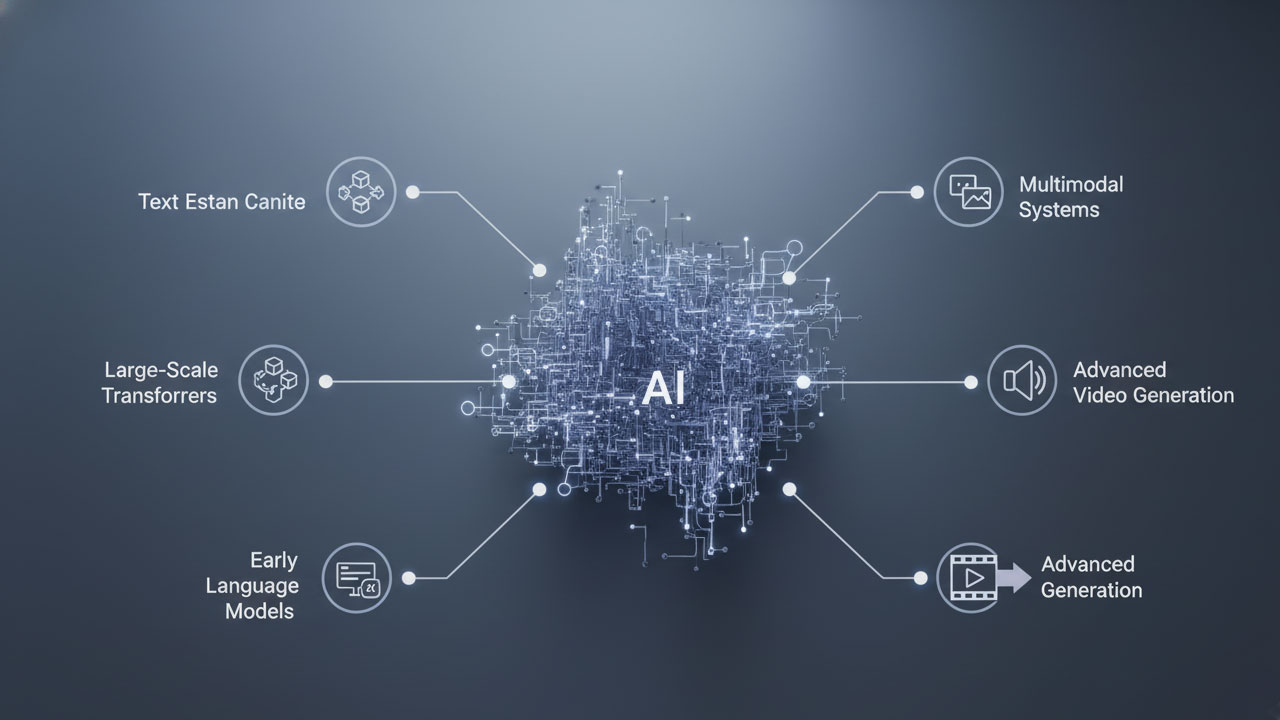
The progression from GPT-1 to Sora reflects broader shifts in how artificial intelligence is conceived, developed, and deployed. Four themes define the significance of these milestones:
- The rise of scale as a driver of capability Larger and better-trained models consistently reveal emergent abilities not anticipated from earlier architectures.
- The move toward multimodality OpenAI’s evolution demonstrates a shift from text-only models to systems that integrate vision, audio, and video.
- Growing emphasis on responsible deployment Discussions surrounding GPT-2, GPT-4, and Sora highlight increasing scrutiny of safety, alignment, and governance.
- Transformation of public and commercial engagement with AI ChatGPT and Sora generated unprecedented public interest, prompting global sectors to reimagine workflows and creative processes.
These trends illustrate how AI is transitioning from a specialized research endeavor to an essential component of societal infrastructure.
Tracing OpenAI’s development from GPT-1 to Sora reveals a decade of rapid and transformative progress. Each model introduced new capabilities, new debates, and new responsibilities. As the world navigates complex questions of AI governance, economic impact, and cultural influence, understanding these milestones provides clarity about where the field has been and where it is headed.
OpenAI’s evolution continues to shape global discourse on the future of artificial intelligence, prompting ongoing evaluation of opportunities and risks as generative systems become more capable, more multimodal, and more deeply integrated into daily life.


