
AI News: The Most Reliable Sources to Track Advances in Artificial Intelligence. Artificial intelligence has become one of the most rapidly evolving frontiers in technology and public policy. As governments regulate new systems, industries invest in AI-driven processes, and research institutions publish breakthroughs at an unprecedented pace, the need for reliable information has never been greater. Tracking the most credible platforms for AI News is now essential not only for technologists but also for policymakers, business executives, students, and general readers seeking a clear understanding of how machine learning, automation, and algorithmic systems are reshaping society.
This article outlines the most authoritative and globally recognized sources that offer comprehensive, accurate, and contextual reporting on artificial intelligence. It also evaluates their editorial strengths, thematic focus, and relevance to different audiences.

Understanding the Need for Trusted AI Information
Coverage of artificial intelligence expands across technical research, business transformation, regulatory developments, and ethical implications. Because the field evolves so quickly, information quality becomes a critical variable. High-quality AI News can influence investment decisions, corporate strategy, academic priorities, and public understanding of emerging risks.
Three pillars define a reliable source of intelligence reporting:
- Editorial discipline and fact checking Outlets with professional editorial processes minimize speculation and contextualize scientific claims.
- Technical expertise Publications informed by researchers, engineers, and scholars produce more accurate interpretations of new technologies.
- Global perspective As AI adoption accelerates worldwide, coverage must reflect regional developments in Asia, Europe, North America, and the Global South.
These attributes guide the selection of platforms highlighted below.
A Landscape of Leading Global AI Information Sources
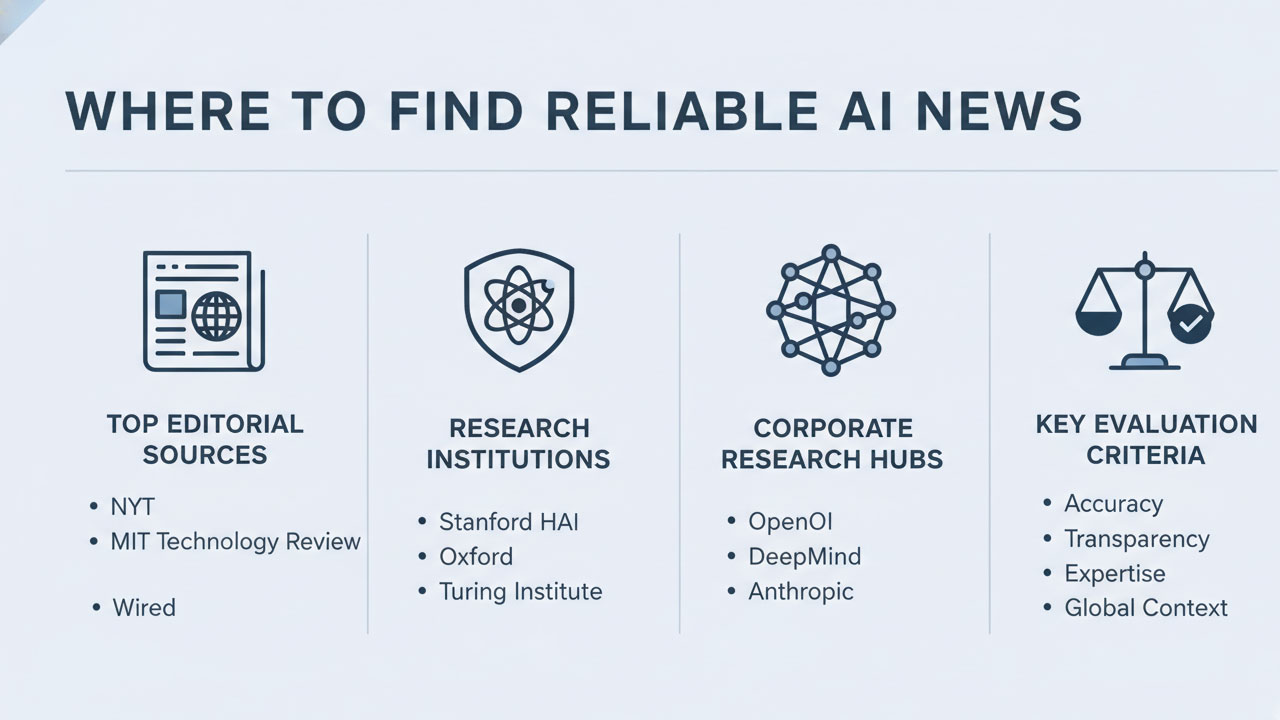
MIT Technology Review
MIT Technology Review remains a benchmark in analytical technology journalism. The publication delves into research trends, industrial applications, and ethical dilemmas with a depth supported by expert contributors. Its AI coverage emphasizes scientific nuance and policy implications, making it one of the most cited sources in academic and corporate environments.
The New York Times, Technology Desk: Advances in Artificial Intelligence
Although a general news organization, The New York Times offers extensive reporting on artificial intelligence through investigative pieces, explanatory journalism, and profiles on major companies. Its coverage is particularly strong on governance issues, regulatory developments, and the societal impact of automated decision-making.
Stanford Institute for Human-Centered Artificial Intelligence (HAI)
Stanford HAI publishes research summaries, expert commentary, and policy analysis. While not a news outlet in the traditional sense, its communications team translates academic research into accessible insights. Readers seeking context behind headline-making discoveries often turn to HAI for noncommercial, research-driven clarity.
The Verge
Known for combining accessible narratives with technical depth, The Verge provides daily updates on industry developments. Its reporting spans new product launches, corporate strategy, and broader conversations about generative AI and machine learning tools shaping modern culture.
Wired Magazine
Wired’s long-form journalism blends cultural observation with investigative reporting. Its AI coverage addresses the human implications of algorithmic systems, from labor dynamics to privacy challenges.
Key Information Table On comparison of leading AI information sources and their editorial strengths.
| Source | Strengths | Audience | Content Focus |
|---|---|---|---|
| MIT Technology Review | Technical depth, research-oriented reporting | Professionals, researchers | AI science, policy, ethics |
| The New York Times | Investigative rigor, global reach | General and professional readers | AI governance, society, business |
| Stanford HAI | Academic authority, policy insight | Researchers, policymakers | Human-centered AI, scholarly analysis |
| The Verge | Fast updates, accessible style | General tech readers | Industry news, product updates |
| Wired | Narrative depth, societal lens | Global readers | Culture, ethics, long-form analysis |
| TechCrunch | Startup focus, venture insights | Entrepreneurs, investors | AI startups, market trends |
| Nature and Science | Peer-reviewed scientific discoveries | Academics, scientists | AI research breakthroughs |
Emerging Categories of AI News Platforms
Research-driven publications
Journals like Nature Machine Intelligence and Science Robotics publish peer-reviewed studies. Although highly technical, they provide first-hand access to breakthroughs before they enter mainstream media.
Industry blogs and corporate research hubs
Institutions such as OpenAI, Google DeepMind, Anthropic, Meta AI, and IBM Research maintain active blogs detailing advancements in model architecture, performance benchmarks, and deployment challenges. Corporate releases require careful interpretation to avoid promotional bias, but they remain essential for understanding technical progress.
Policy-focused organizations
Groups such as the OECD, the Center for AI Safety, and the Alan Turing Institute offer analyses on regulatory matters, governance frameworks, and risk mitigation strategies. Their reports are frequently used by legislators and international agencies.

Evaluating the Reliability of AI Information
With thousands of websites now repackaging technology updates, distinguishing high-quality AI News from low-quality content has become increasingly complex. Readers can use the following criteria to assess reliability:
Provenance Is the information sourced from reputable institutions, peer-reviewed journals, or confirmed corporate statements?
Depth Does the reporting include context, counterarguments, and expert commentary?
Transparency Are sources clearly identified? Are uncertainties acknowledged?
Longevity Established publications have clearer accountability structures than newly launched content mills.
These criteria ensure that coverage maintains an accurate representation of the field rather than echoing sensationalized claims about future threats or promises of immediate transformative breakthroughs.
The Future of AI News Consumption
Automation has transformed the news ecosystem itself. Several research initiatives are exploring how large language models can process scientific papers, filter policy documents, and generate abstracts. However, editorial oversight remains indispensable. Even as AI tools assist journalists, human editors safeguard accuracy, context, and ethical standards.
Newsrooms worldwide are incorporating AI monitoring tools to track regulatory developments, model releases, and scientific papers, enabling faster reporting while maintaining professional verification.
The next decade will likely see:
- More cross-disciplinary newsrooms combining expertise from computer science, law, and public policy
- Greater attention to the social and economic consequences of AI adoption
- Expanded academic-media collaborations to communicate scientific findings responsibly
- Growing emphasis on transparency in AI-generated content within journalism itself
These shifts will shape how global audiences engage with reporting on technological change.
Why High-Quality AI News Matters
Artificial intelligence influences global markets, critical infrastructure, creative industries, and political discourse. Reliable information helps stakeholders understand risk and opportunity:
- Businesses can benchmark competitors and evaluate investment trends
- Governments can craft informed regulatory frameworks
- Researchers can monitor global progress and emerging disciplines
- Students and readers can develop a balanced understanding of complex systems
In an era of rapid innovation, the quality of AI News directly affects public literacy and decision-making.
Artificial intelligence is no longer an isolated field of computer science. It intersects with governance, economics, culture, and ethics. As a result, staying informed requires turning to platforms that blend editorial rigor with technical expertise. The sources outlined above represent a diverse ecosystem of journalism, research, and policy analysis that helps readers navigate one of the most consequential technological transformations of the modern era.
High-quality AI News not only tracks advancements but also contextualizes their implications. As the pace of innovation accelerates, these trusted platforms will remain central to understanding how artificial intelligence evolves and how it reshapes our shared future.


