
U.S. Supreme Court Decision Shifts Transgender Passport Rights Enforcement. In a decisive ruling on December 6, 2025, the U.S. Supreme Court paved the way for a sweeping shift in Transgender Passport Rights. The conservative-majority court cleared the enforcement of a Trump-era policy requiring passports to reflect the sex assigned at birth. This decision affects thousands of transgender and nonbinary Americans, effectively halting the option for self-identification on federal travel documents.
The ruling came in a 6-3 vote and represents a significant victory for the current administration’s conservative social agenda. By authorizing the policy while legal challenges continue in lower courts, the Supreme Court has placed a longstanding practice of gender recognition under federal scrutiny.
Ending Decades of Flexible Passport Policy
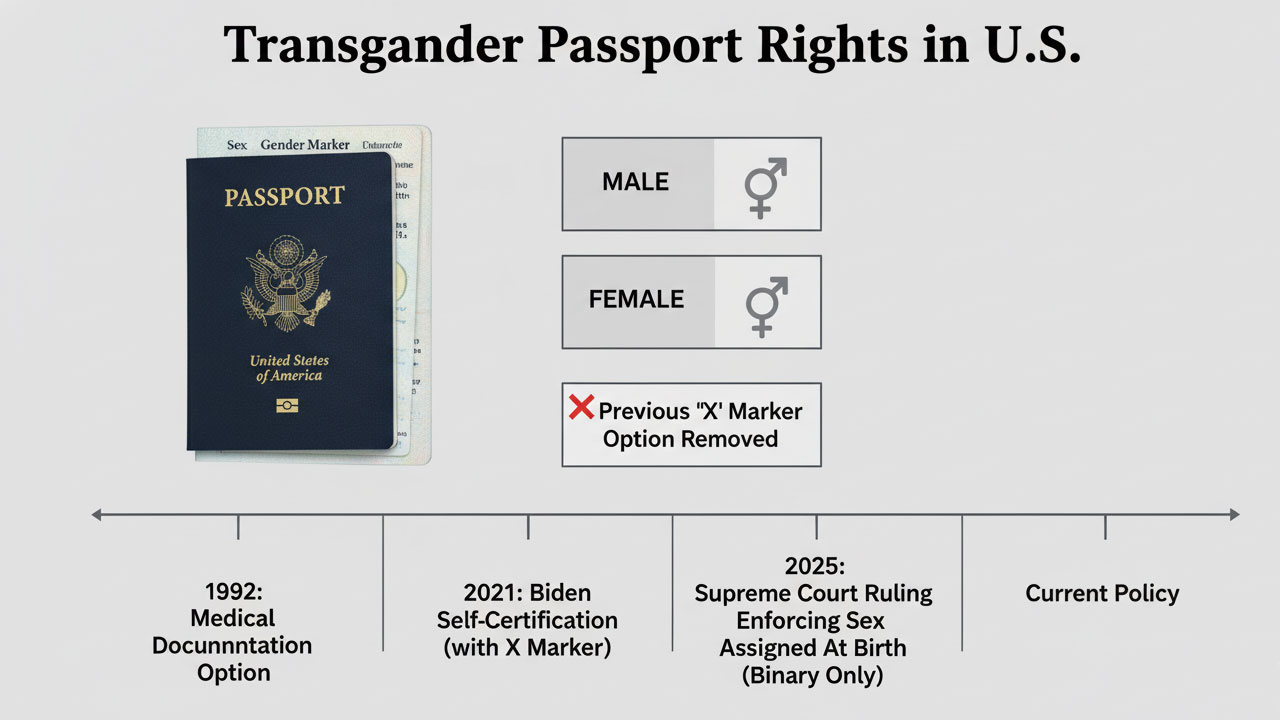
For more than thirty years, the State Department had gradually expanded options for passport holders to correct gender markers. Since 1992, applicants could obtain passports reflecting their gender identity if accompanied by medical documentation. During the Biden administration, this policy shifted further, allowing individuals to self-certify gender identity and introducing an “X” option to recognize nonbinary or gender-diverse identities.
The recent Supreme Court action overturns these reforms. Under the new enforcement, only the two sexes listed on birth certificates—male or female are recognized. The ruling thus reverses decades of evolving federal policy, creating immediate challenges for applicants seeking new or renewed passports.
Key Information On Transgender Passport Rights Enforcement
| Category | Details |
|---|---|
| Court Decision | U.S. Supreme Court, 6-3 ruling |
| Policy Affected | Passport gender markers |
| Previous Option | Self-certification and “X” marker under Biden |
| Current Enforcement | Sex assigned at birth only |
| Legal Mechanism | Emergency “shadow docket” decision |
| Challenged By | Multiple civil rights groups and federal lawsuits |
| Lower Court Action | April injunction blocked policy (Judge Julia Kobick) |
| Constitutional Issue | Fifth Amendment – Equal protection |
| Scope | Federal passport applications |
| Effective Immediately | Yes, pending lower court proceedings |
The policy reversal traces back to a January executive order issued earlier in 2025. The order stated that the United States would formally recognize only two sexes, defining sex as determined by biology and documented on birth certificates. The State Department subsequently revised passport rules to align with this directive, removing the self-certification pathway for transgender and nonbinary applicants.
Legal experts have noted that this change represents not only an administrative adjustment but also a philosophical departure from the previous understanding of gender. The policy has sparked widespread debate over federal authority versus individual civil liberties, particularly in areas of gender recognition and constitutional protection.
Immediate Legal Implications
The Supreme Court’s ruling was issued through its emergency “shadow docket,” a mechanism allowing certain policies to take effect while litigation continues. As a result, Americans seeking passports face a binary-only classification system that may conflict with personal identification documents issued by states recognizing nonbinary or third-gender classifications.
Civil liberties advocates have expressed concern that the decision creates legal uncertainty. “This ruling puts thousands of Americans in a state of limbo, limiting access to a fundamental document of citizenship,” said one policy analyst familiar with gender recognition law.
Broader Cultural and Judicial Context
This ruling is emblematic of a larger trend within the Supreme Court under its conservative majority. Over recent years, the court has consistently backed policies aligned with social conservatism, ranging from restrictions on military service eligibility to limitations on federal research funding related to gender issues.
The policy was originally challenged as unconstitutional discrimination. In April, Judge Julia Kobick of the U.S. District Court in Boston blocked the rule, stating that it was rooted in “irrational prejudice” and likely violated Fifth Amendment equal protection rights. The Supreme Court’s reversal underscores the growing tension between federal directives and judicial interpretations of civil rights protections.
Potential Conflicts with State Laws
A key concern among legal scholars is the potential clash between federal and state recognition of gender identity. Several states, including California and Oregon, officially recognize nonbinary markers on identification documents. The new federal enforcement could create inconsistencies in travel, healthcare, and employment verification, posing significant challenges for affected individuals.
“The federal stance may undermine state-level protections, creating a patchwork of legal recognition that complicates everyday life for transgender and nonbinary citizens,” explained a constitutional law professor at a major U.S. university.
Impact on Transgender and Nonbinary Communities
The ruling has immediate practical consequences. Passport applications submitted after the decision must reflect the sex assigned at birth, irrespective of an individual’s gender identity. This effectively removes the option to self-identify or use nonbinary markers in federal travel documents, restricting a crucial aspect of personal autonomy and identity validation.
Advocates warn that the policy signals a broader federal retrenchment on gender rights. Beyond travel documents, the ruling may influence other federal programs, including healthcare access, social security benefits, and military service eligibility. Experts note that the decision reflects a recalibration of federal recognition for transgender and nonbinary identities that could ripple across multiple areas of public life.
Civil Rights Litigation Ahead
Legal challenges are expected to continue in lower courts. Civil rights organizations are preparing to argue that the policy constitutes unconstitutional discrimination under the Fifth Amendment. These cases will likely explore whether the federal government has the authority to impose a binary-only classification on passports when states have recognized third-gender or nonbinary identities.
“The Supreme Court’s shadow docket ruling is temporary in nature. The substantive constitutional questions remain unresolved and will be litigated over the coming months and years,” noted a senior legal analyst in Washington, D.C.
International Implications
Beyond domestic law, this ruling may affect international travel and recognition of U.S. passports abroad. Many countries allow nonbinary passport markers, and discrepancies could complicate immigration, visa applications, and entry requirements. Travel organizations have already begun advising U.S. citizens about potential difficulties for transgender and nonbinary individuals traveling internationally.
Policy Experts Weigh In
Experts in civil rights and gender law emphasize the significance of the Supreme Court’s decision in the broader context of American social policy. “This is not simply about travel documents; it’s about the federal government’s recognition of identity itself,” said a leading scholar of constitutional law.
The ruling also reflects ongoing cultural debates surrounding gender and the extent to which federal institutions adapt or resist social changes. While supporters argue the policy reinforces clarity in federal documentation, critics stress that it undermines civil liberties and harms a vulnerable population.
A Pivotal Moment for Transgender Rights
The Supreme Court’s ruling on Transgender Passport Rights marks a critical juncture in U.S. civil rights law. By enforcing a binary-only classification system, the decision reshapes the legal landscape for federal gender recognition. Transgender and nonbinary Americans now face restricted access to a fundamental document of citizenship, with implications extending into travel, legal status, and everyday life.
As lawsuits progress through lower courts, the ultimate resolution of this policy remains uncertain. Nonetheless, the decision underscores a growing divide in federal recognition of gender identity and signals a pivotal shift in how transgender rights are adjudicated and implemented in the United States.


