
The Abandons Review! Despite strong leads in Gillian Anderson and Lena Headey, Kurt Sutter’s Netflix western The Abandons suffers from truncated storytelling and thin characters.
Kurt Sutter has built a career on excess. From the Machiavellian brutality of Sons of Anarchy to the operatic violence of The Bastard Executioner, his signature as a showrunner has always been “more”—more runtime, more viscera, more emotional extremity. It is jarring, then, to encounter The Abandons, his new western for Netflix, which premieres on Thursday. The seven-part drama is defined not by its surplus, but by its startling insufficiency.
The series, set in the Washington Territory in 1854, stars two titans of television drama: Gillian Anderson (The X-Files, The Crown) and Lena Headey (Game of Thrones). On paper, it is a revisionist western pitting two matriarchs against one another in a battle for land, legacy, and the soul of a frontier town called Angel’s Ridge. In execution, however, it is a confusingly spare and truncated affair, evidently scarred by behind-the-scenes turmoil that saw its episode count slashed and its creator depart before production wrapped.
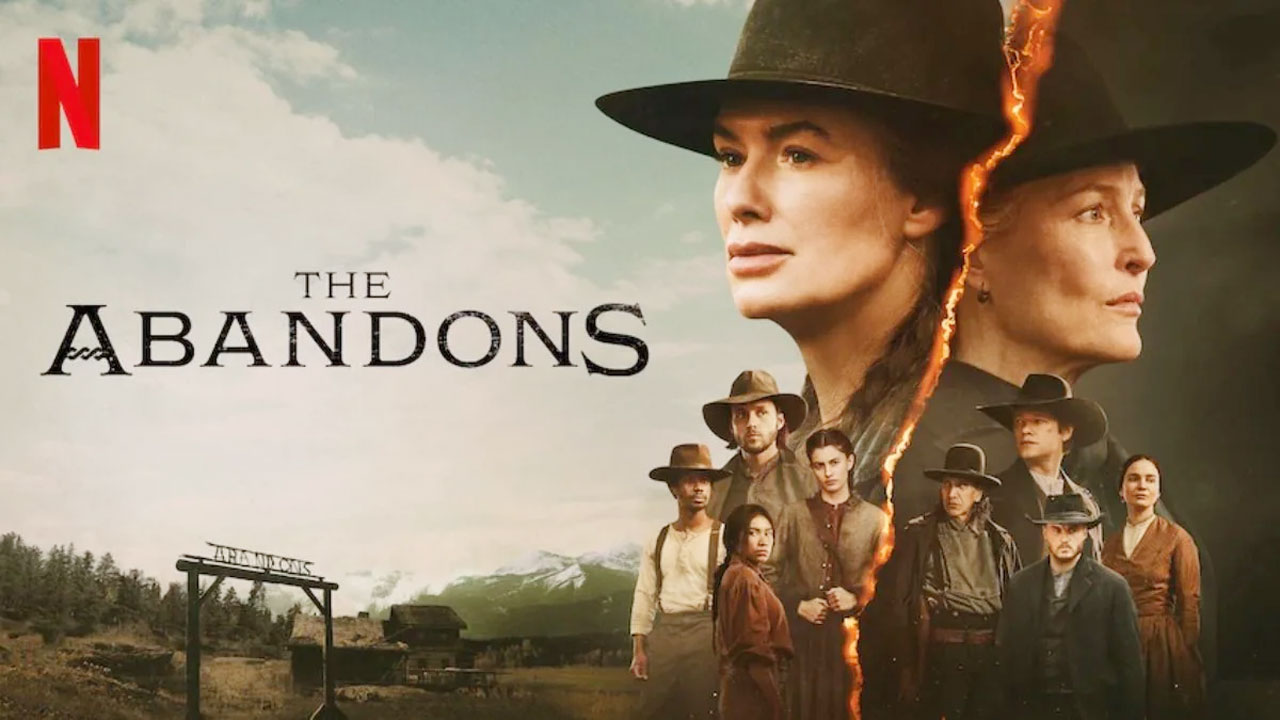
A Tale of Two Matriarchs
The narrative engine of The Abandons is the conflict between Constance Van Ness (Ms. Anderson) and Fiona Nolan (Ms. Headey). Constance is a wealthy mining magnate who essentially owns Angel’s Ridge, controlling the local economy, the mayor (played by Patton Oswalt), and the law. She is a woman of icy resolve and distinct European pedigree, seeking to secure her family’s future as the local mines begin to run dry.
Her salvation lies in a vein of silver beneath Jasper Hollow, a tract of land occupied by Fiona Nolan. Fiona, a devout Irish Catholic widow, runs a ranch named “The Abandons.” Unlike Constance, whose power is inherited and financial, Fiona’s strength is communal. Unable to bear children of her own, she has adopted a family of four orphans: Elias (Nick Robinson), Dahlia (Diana Silvers), Albert (Lamar Johnson), and Lilla (Natalia del Riego).
The setup promises a clash of ideologies—Protestant capital versus Catholic communalism, establishment power versus scrappy survivalism. Yet, these themes are introduced only to be immediately discarded as the series races through its plot points.
The Missing Pieces
The most glaring issue with The Abandons is the palpable sense that large chunks of the story are missing. Originally ordered as a 10-episode season, the final product consists of only seven installments, with four clocking in under 40 minutes. This brevity comes at a steep cost to character development.
The “family” dynamic at the heart of Fiona’s ranch is particularly undercooked. The show asks viewers to invest in the bonds between Fiona and her adopted children without ever establishing how this diverse group—including Black and Native American siblings—came together or how long they have functioned as a unit. Characters like Albert and Lilla are frequently sidelined, disappearing for stretches of time or being handed perfunctory subplots that add little to the overarching narrative.
Even the central conflict suffers. The religious tension hinted at in the pilot—Fiona’s volatile Catholicism versus Constance’s withheld Protestantism—evaporates quickly. When a priest played by Timothy V. Murphy arrives, he serves more as set dressing than spiritual counsel, a missed opportunity for a writer like Sutter who usually relishes exploring the darker corners of faith.
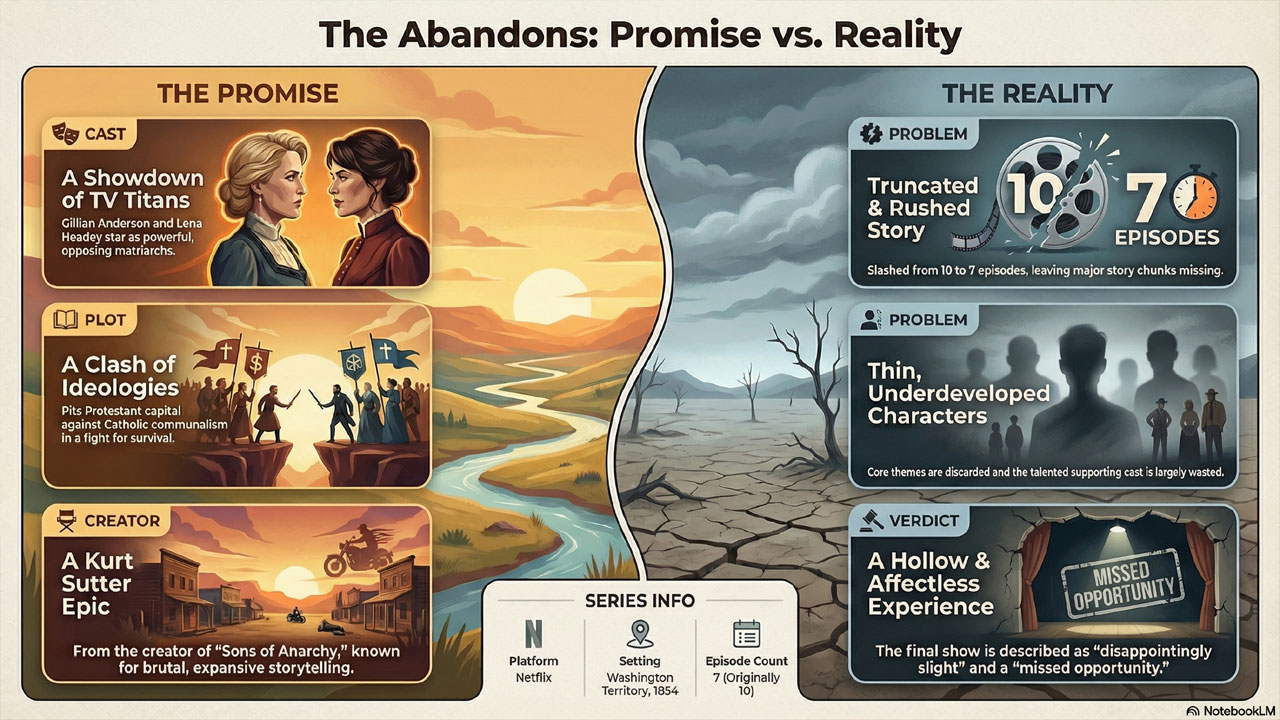
Key Information on The Abandons Review
| Title | The Abandons |
| Platform | Netflix |
| Premiere Date | December 4, 2025 |
| Showrunner | Kurt Sutter (departed mid-production) |
| Lead Cast | Gillian Anderson, Lena Headey |
| Episode Count | 7 (Originally 10) |
| Setting | Washington Territory, 1854 |
| Verdict | Disappointingly slight; lacks character depth. |
Performances in a Vacuum
Despite the thin material, the lead actresses work hard to elevate the proceedings. Gillian Anderson is particularly effective, breathing subtle menace into Constance Van Ness. She plays the role with a steely, controlled affect that makes her explosions of violence all the more jarring. Lena Headey, hamstrung by a character whose motivations seem to shift scene by scene, struggles with consistency but still manages to bring a fierce physicality to the role.
The supporting cast, however, is largely wasted. Actors like Nick Robinson and Lucas Till (playing Constance’s son) are given little to do beyond brooding. Notable character actors including Ryan Hurst and Katey Sagal—veterans of the Sutter universe—appear in roles that feel like placeholders, relying on the actors’ inherent screen presence rather than actual writing.
More – Tarantino Criticizes Paul Dano as ‘Weakest Actor’ in There Will Be Blood
Production Woes Visible on Screen
The truncated nature of the series also impacts its visual language. While filmed on location in Alberta, the show rarely capitalizes on the grandeur of its setting. Action sequences, such as a cattle stampede in the pilot, are marred by muddy CGI and poor lighting. Directors Otto Bathurst and Gwyneth Horder-Payton seem constrained, unable to deliver the visceral set pieces that usually define the genre.
It is only in the finale that the show begins to resemble a Kurt Sutter production, delivering beats of ruthless, narratively consequential violence. But because the preceding six episodes failed to build meaningful connections with the characters, this violence feels affectless rather than tragic.
Conclusion
The Abandons stands as a frustrating example of “what might have been.” It sits awkwardly in Netflix’s library of westerns, lacking the lyrical beauty of Godless or the raw brutality of American Primeval.
Viewers are left with a series that is briskly watchable but ultimately hollow. It is a show that feels, quite literally, abandoned—cut to pieces, stripped of its thematic weight, and ending on a cliffhanger that feels less like a promise of future seasons and more like a sign of a story unfinished. For fans of the genre and the talent involved, it is a missed opportunity of significant proportions.


