
Beyond “Fun”: Choosing the Right Entertainment Synonym for Creative Writing.Language is the foundation of storytelling, and the words an author chooses profoundly shape a reader’s perception. In creative writing, the word “fun” is ubiquitous, yet its overuse can dilute narrative richness. Authors seeking precision often explore alternatives—each carrying subtle differences in tone, connotation, and stylistic impact. Understanding the proper entertainment synonym is not simply an exercise in variety; it is a deliberate tool to refine mood, theme, and engagement in storytelling.
This article delves into the nuances of selecting the most appropriate entertainment synonym for different contexts, offering writers strategies to enhance both prose and dialogue. Drawing on linguistic theory, literary examples, and practical guidance, the discussion emphasizes clarity, precision, and expressive depth.

The Importance of Word Choice in Creative Writing
Why Vocabulary Matters?
Effective storytelling depends on nuanced vocabulary. Words convey not only meaning but also tone, rhythm, and reader expectations. Over-reliance on generic terms like “fun” can flatten narrative energy, whereas carefully chosen synonyms can evoke specific atmospheres or emotions.
For example, describing an evening as “entertaining” conveys mild pleasure, while “amusing” emphasizes humor, and “captivating” suggests deep engagement. Understanding these distinctions is central to sophisticated narrative construction.
How Synonyms Affect Perception?
Even near-identical words carry subtle connotations. Consider:
| Word | Connotation | Typical Usage |
|---|---|---|
| Fun | Light-hearted enjoyment | Casual, informal contexts |
| Amusement | Humorous or pleasurable distraction | Social or recreational settings |
| Entertainment | Broader consumption of leisure, culture, or performance | Formal, descriptive, or literary contexts |
| Enjoyment | Personal satisfaction or delight | Reflective or emotional tone |
| Recreation | Physical or mental diversion | Activity-focused contexts |
By selecting a synonym with the appropriate nuance, writers can enhance immersion and guide reader interpretation.
Exploring Common Entertainment Synonyms
Amusement
Amusement emphasizes humor or light-heartedness. In narrative scenes where characters laugh, play, or experience joyful distraction, “amusement” conveys immediacy and levity. Literary examples include comedic interludes or whimsical character interactions.
Example: The children’s faces lit up with amusement as the magician performed his final trick.
Enjoyment
Enjoyment highlights subjective pleasure. Unlike amusement, it suggests personal satisfaction and can encompass emotional or aesthetic dimensions. In reflective passages, “enjoyment” underscores depth of experience rather than superficial fun.
Example: She closed her eyes, savoring the enjoyment of a warm afternoon in the garden.
More: I need a dictionary/thesaurus that will improve my creative writing.
Recreation
Recreation focuses on purposeful diversion. In creative writing, this term can anchor action-based scenes, implying a structured or intentional activity, often with social or physical undertones.
Example: His evenings were filled with recreation, from rowing along the river to reading novels by candlelight.
Diversion
Diversion suggests temporary distraction from routine or stress. It is often suitable in narrative contexts highlighting escape, relaxation, or subtle tension relief.
Example: The piano provided a welcome diversion from the pressures of city life.
Amusement vs. Entertainment
While “amusement” conveys playful enjoyment, “entertainment” has a broader semantic range, encompassing music, theater, storytelling, or digital media. Creative writers benefit from recognizing this distinction to avoid monotony.
Contextual Considerations for Synonym Selection
Audience and Tone
The effectiveness of a synonym depends on target readers and intended tone. For children’s literature, words like “amusement” or “fun” resonate, while adult literary fiction may benefit from “diversion,” “pleasure,” or “entertainment.”
Character Voice and Perspective
A character’s diction informs narrative voice. Formal characters may refer to “entertainment” or “diversion,” whereas casual characters might favor “fun” or “amusement.” Aligning word choice with voice enhances authenticity.
Genre Constraints
Genre influences synonym selection. Fantasy or whimsical fiction may emphasize “amusement” or “merriment,” while historical or literary fiction might prefer “recreation” or “entertainment” to maintain stylistic consistency.
Medium and Format
Writers working across formats—novels, short stories, scripts, or interactive media—must consider how synonyms read aloud or appear visually. Certain words carry weight when spoken, others when seen in prose.
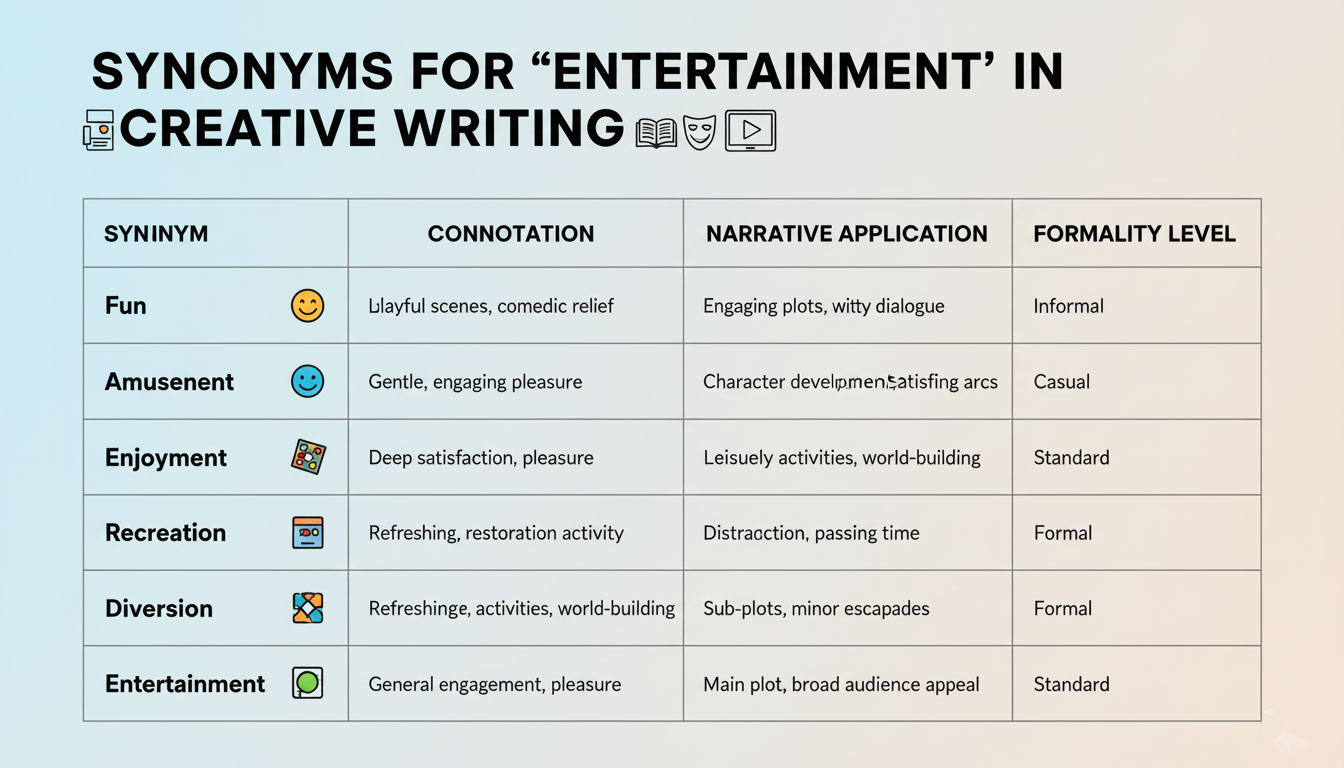
Key Information Table On: Beyond “Fun”: Choosing the Right Entertainment Synonym for Creative Writing
| Synonym | Connotation | Narrative Application | Formality Level |
|---|---|---|---|
| Fun | Casual, light-hearted | Dialogue, informal description | Low |
| Amusement | Humor, playful | Comedic or whimsical scenes | Medium |
| Enjoyment | Satisfaction, emotional | Reflective or aesthetic moments | Medium-High |
| Recreation | Activity, structured diversion | Action or leisure-focused narrative | Medium |
| Diversion | Escape, temporary relief | Character introspection, tension relief | Medium |
| Entertainment | Broad cultural or leisure activity | Descriptive, formal, or literary | High |
Strategies for Writers
1. Contextual Synonym Matching
Analyze scene purpose: Is the goal humor, reflection, or escapism? Match the synonym to the desired effect rather than defaulting to “fun.”
2. Layering Synonyms
Writers can combine synonyms with modifiers to enrich meaning. For instance, “delightful recreation” conveys both pleasure and structured activity, adding textual depth.
3. Balancing Formality and Readability
Ensure synonyms match overall tone. A term that feels formal in a casual context may disrupt reader engagement. Conversely, casual terms in elevated prose may undermine narrative authority.
4. Testing Rhythm and Flow
Read passages aloud to gauge how synonyms affect sentence rhythm and cadence. Certain words may improve narrative flow or reinforce thematic resonance.
5. Leveraging Thesauri and Corpora
Tools like thesauri, corpus analysis, or digital writing assistants can help identify synonyms in authentic usage contexts, reducing the risk of semantic misalignment.
Case Studies: Synonym Application in Literature
Children’s Literature
In classic children’s stories, playful terms like “amusement” appear frequently to convey joy and curiosity. Authors often pair it with vivid imagery to create immersive experiences.
Example: The carnival offered endless amusement, from the carousel’s whirling horses to the cotton candy stalls.
Literary Fiction
In adult literary fiction, “entertainment” or “diversion” often emphasizes structured or reflective leisure. It subtly informs character development and socio-cultural commentary.
Example: Evening gatherings at the manor were designed more for refined entertainment than spontaneous laughter.

Screenwriting and Dialogue
In dialogue-heavy formats, “fun” remains effective for immediacy, while “amusement” or “enjoyment” provides nuance, revealing character mood or sophistication.
Example: “We had so much fun at the festival!” – casual, enthusiastic “The evening’s amusement exceeded my expectations,” – reflective, elevated tone
Beyond Synonyms: Expanding Lexical Range
Exploring Related Concepts
Authors can expand their vocabulary by considering words that imply aspects of entertainment without being direct synonyms:
- Merriment – joy, laughter
- Festivity – celebratory context
- Pleasure – personal gratification
- Delight – aesthetic or emotional enjoyment
- Pastime – habitual leisure activity
Avoiding Overuse
Over-reliance on one word flattens narrative energy. Rotating among synonyms based on context ensures textual freshness and reader engagement.
Consider Cultural Nuance
Certain terms carry cultural connotations. For instance, “recreation” may suggest formal activity in some contexts, while “fun” is universally casual. Awareness of audience background enhances clarity and resonance.
Selecting the right entertainment synonym is more than a linguistic exercise—it is an essential tool for crafting compelling, immersive creative writing. From casual “fun” to reflective “enjoyment,” each option carries unique connotations that influence tone, mood, and narrative depth. Writers who deliberate on word choice, consider context, and strategically rotate synonyms can elevate prose, enrich character voice, and captivate readers.
By embracing nuanced vocabulary and understanding subtle semantic differences, authors can move beyond generic expressions, achieving clarity, style, and expressive precision in their storytelling.


