
Anthropic News: Claude AI Challenges ChatGPT in Creative Writing. In the rapidly evolving landscape of generative artificial intelligence, Anthropic has emerged as a formidable challenger to existing industry leaders. The company’s flagship model, Claude, has moved into direct competition with ChatGPT, raising important questions about how users and industries will adopt advanced systems for creative writing, research, and professional communication. Much of the recent discussion covered in Anthropic News focuses on the growing rivalry between these two models and how writers, journalists, and analysts are recalibrating their expectations for AI-driven creativity.
The competition is not merely technological. It is also philosophical. Anthropic emphasizes a safety-first approach built around Constitutional AI, while OpenAI’s development strategy focuses intensely on broad capabilities, dynamic model scaling, and rapid deployment. As a result, the creative writing space now benefits from two distinct but overlapping approaches, both shaping how narrative tools are designed, trained, and evaluated.

This article examines the competitive dynamics between Claude and ChatGPT, the corporate philosophies behind their development, and what their rivalry means for global creative industries.
The Rise of Anthropic and Its Creative Agenda
Anthropic was founded in 2021 by former OpenAI researchers with the objective of building “reliable, interpretable, and steerable” AI systems. Its model family, known simply as Claude, was developed around the principle that AI systems must behave predictably in ambiguous or open-ended scenarios. This framework has naturally shaped the way Claude performs in creative writing.
The model gained early traction among writers, editors, and long-form content creators because of its ability to structure narratives logically while maintaining a strong ethical alignment. As detailed in recent Anthropic News coverage, users increasingly select Claude for tasks that require subtle emotional tone, sustained narrative coherence, or detailed analytical depth.
Many writers cite Claude’s notable strengths:
- Long-context processing that enables it to handle entire manuscripts
- High compliance with user instructions
- A balanced prose style that avoids sensationalism
- A strong ability to internalize narrative arcs
By contrast, ChatGPT tends to excel in high-velocity idea generation, stylistic transformation, and rapid rewrites, giving each model a unique niche.
How Claude AI Produces Creative Writing
Claude’s approach to creative writing is guided by Constitutional AI, a system that allows the model to self-critique and refine its output based on a set of guiding principles. These principles help it avoid harmful content while still allowing for creative expression.
Key Features that Distinguish Claude in Creative Tasks
- Long-Context Narrative Structuring Claude can retain and process significantly longer texts than previous models, giving it an advantage in drafting multi-chapter fiction, investigative long-reads, or academic writing.
- Tone Consistency and Emotional Subtlety Writers often highlight Claude’s ability to maintain consistent emotional tone across several thousand words, an important requirement for novelists and screenwriters.
- Logic and Coherence Over Long Distances Claude is less likely to lose track of names, characters, or plot points, improving the reliability of creative collaboration.
- Ethical Guardrails This ensures creative work stays within boundaries aligned with safety standards, making Claude appealing for educational publishers and corporate environments.
These strengths position Claude as a precision tool for structured creativity, whereas ChatGPT often delivers broader stylistic flexibility and a more experimental creative range.
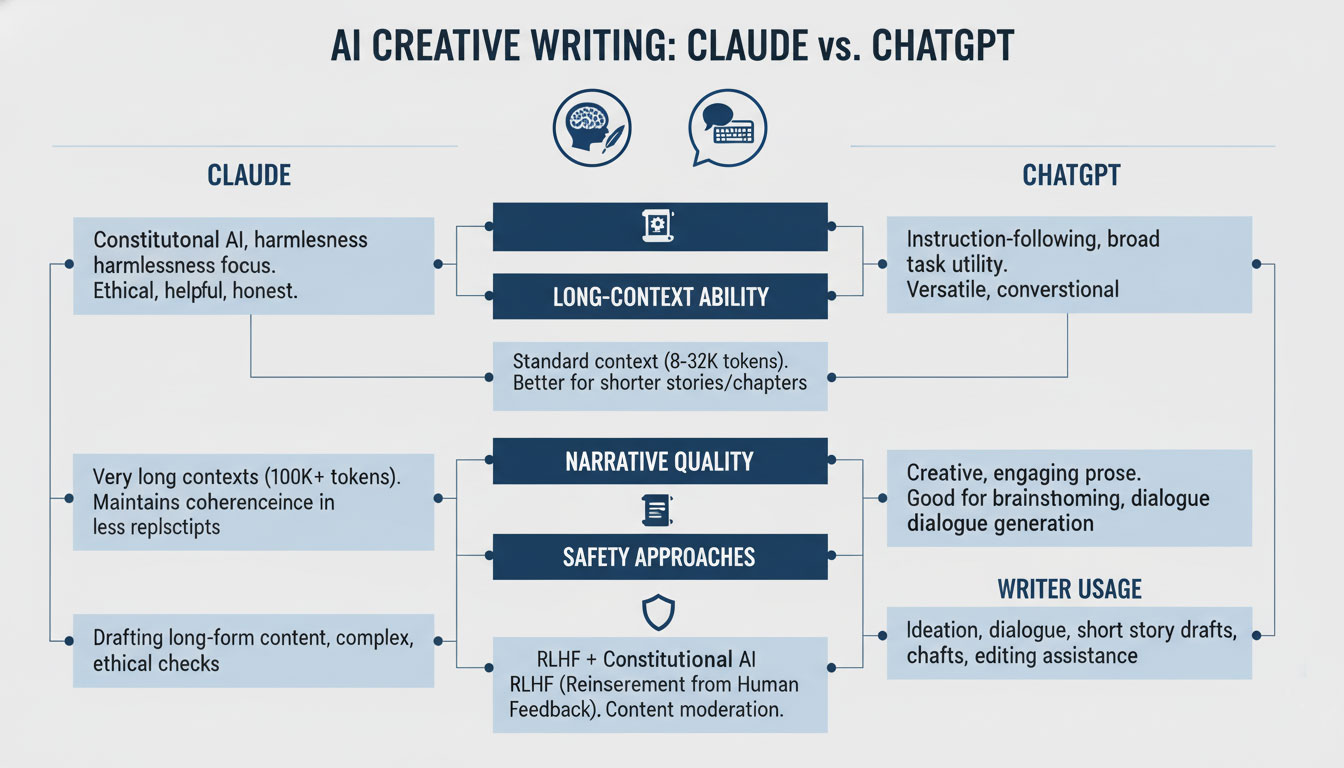
Competitive Positioning: Claude vs. ChatGPT
The rivalry between Anthropic and OpenAI mirrors broader competitive movements in Silicon Valley. Both companies operate within a landscape shaped by platform partnerships, enterprise licensing, and rapid model iteration. However, the creative writing market adds an additional layer: user trust.
Many journalists and creative professionals prefer model predictability, especially when managing complex projects. Others prioritize imaginative risk-taking, stylistic range, or high-speed idea generation. Both preferences shape how users choose between Claude and ChatGPT.
Key Information Table On: Comparative Overview
| Feature Area | Claude (Anthropic) | ChatGPT (OpenAI) | Market Implications |
|---|---|---|---|
| Creative Tone | Balanced, subtle, introspective | Varied, bold, adaptive | Users choose based on narrative style preference |
| Long Context | Strong extended recall | Good, but varies by version | Claude favored for books and research |
| Safety | Constitutional AI safeguards | RLHF plus policy layers | Claude preferred in compliance-heavy sectors |
| Ideation Speed | Moderate | Very fast | ChatGPT favored in brainstorming |
| Narrative Cohesion | Highly consistent | Strong but variable | Claude preferred for long-form writing |
This table illustrates the nuanced segmentation of the creative AI market, driven in part by differing user expectations.
Claude’s Growing Adoption in Publishing and Journalism
Publishing houses, newsrooms, and academic institutions increasingly adopt Claude for tasks such as editorial assistance, story outlining, fact-checking, and long-form content planning. Recent Anthropic News reporting highlights pilot programs where Claude supports:
- Book manuscript reviews
- Academic paper structuring
- Investigative journalism research
- Historical analysis and archival synthesis
The model’s ability to process and analyze large volumes of text gives it a distinct advantage in industries that rely on deep reading, not just fast writing.
More: Anthropic Education Report: How educators use Claude
Why Professional Writers Are Experimenting with Claude
- It reduces narrative drift in long texts.
- It handles research-heavy tasks more reliably.
- It provides a checked, moderated tone suitable for professional settings.
Despite this momentum, ChatGPT remains the most widely recognized consumer-facing tool, giving OpenAI a scale advantage in everyday usage.
AI Safety and Ethics: Anthropic’s Strategic Differentiator
One of Anthropic’s most notable contributions to the AI sector is its focus on safety. Constitutional AI attempts to give models an internal framework of reasoning that guides decisions in uncertain conditions. The framework does not eliminate risk but offers greater transparency into how the model interprets potentially harmful instructions.
This approach makes Claude appealing to organizations with strict compliance obligations, including law firms, research institutes, and media companies. ChatGPT, meanwhile, continues to offer advanced capabilities but has faced ongoing scrutiny about hallucinations, rapid model release cycles, and content alignment.
Analysts observing this trend note that Anthropic positions itself not just as an AI competitor but as a responsible technology steward. This distinction may help the company secure institutional contracts in sectors requiring risk-mitigation tools.

Market Dynamics and Funding Landscape
Anthropic’s commercial ascent has been bolstered by significant corporate partnerships and multi-billion-dollar investments from major technology companies. This funding has strengthened its capacity to train large models and challenge established AI providers.
ChatGPT, backed by extensive resources and infrastructure, continues to scale rapidly across global markets. The rivalry has accelerated breakthroughs in model size, training efficiency, and multimodal capabilities. This competitive cycle mirrors developments in early consumer internet providers, with rapid iteration driving wider adoption.
Industry analysts expect the generative AI market to reach hundreds of billions of dollars in value, with creative writing tools representing a meaningful share. As AI systems become embedded in newsroom workflows, entertainment production, marketing, and education, models like Claude and ChatGPT will expand into multimedia content creation, video narrative structuring, and multimodal storytelling.
How Writers Are Integrating AI into Their Creative Process
Across the creative landscape, professional writers describe AI as a collaborative partner rather than a replacement. AI tools help with idea generation, character development, narrative scaffolding, and stylistic experimentation.
Writers choose Claude for:
- Deep narrative consistency
- Reflective analysis
- High-integrity tone
- Manuscript-level revisions
They choose ChatGPT for:
- Brainstorming
- Voice transformation
- Rapid rephrasing
- Experimental writing modes
Both models enhance productivity, but the relationship between human creativity and AI remains symbiotic rather than competitive.
Industry Outlook: Will Claude or ChatGPT Lead the Creative Future?
Anthropic’s strategic approach positions Claude as a leading tool for structured creativity and professional writing. ChatGPT continues to dominate in versatility, cultural ubiquity, and rapid content generation.
Over the next several years, the creative writing market will likely evolve into specialized user segments:
- Novelists and long-form writers may prefer Claude.
- Marketing and social media teams may rely on ChatGPT for speed.
- Journalists and analysts may use both models depending on task complexity.
Anthropic News coverage suggests that this dual-model ecosystem will continue to define the creative AI market, with neither system achieving absolute dominance. Instead, users will adopt the model that best aligns with their creative workflow.


